Watching your dog tremble, pace, or panic the moment you leave is heartbreaking — so it's natural to wonder whether anxiety meds for dogs could help. Sometimes they can, but medication is only ever one piece of the picture, and only a licensed professional can prescribe it. This guide explains how these options work and when they're considered, so you can have a calmer, more informed conversation about your dog's care.
PawChamp doesn't diagnose conditions or recommend specific medications. If your dog is struggling, please talk to a licensed professional — this article is for understanding, not a substitute for that visit.
Key Takeaways
Anxiety meds for dogs are one tool, not a standalone cure.
Only a licensed professional should diagnose or prescribe.
Dog anxiety symptoms range from pacing and whining to destruction.
Training and routine are the foundation of dog anxiety treatment.
Many dogs improve dramatically with behavior work alone.
Understanding Dog Anxiety and Its Symptoms
Before anything else, it helps to understand what you're seeing. Dog anxiety can stem from separation, loud noises, past trauma, or a big change at home. The most common dog anxiety symptoms to watch for include:
Pacing, restlessness, or an inability to settle.
Whining, barking, or howling — especially when home alone.
Trembling, panting, or heavy drooling.
Destructive chewing, digging, or scratching at doors and windows.
Indoor accidents from an otherwise house-trained dog.
For some dogs, steady routine and companionship — the same comfort behind the idea of an emotional support dog — makes a genuine difference.
💭 Worth knowing
Anxiety isn't “bad behavior.” A dog who shreds the couch during a thunderstorm isn't being naughty — he's panicking. Recognizing fear as fear, not defiance, completely changes how we help, and it's the first real step toward progress.
How Do Anxiety Meds for Dogs Work?
When behavior work alone isn't enough, a professional may consider medication. Broadly speaking, anxiety meds for dogs work by influencing brain chemistry — easing the constant “high alert” state so a dog can actually learn to feel safe. Some are given daily, others only before a known trigger, and the right dog anxiety treatment is always tailored to the individual dog. It's worth remembering that the best anxiety meds for dogs are simply the ones a professional chooses based on your dog's history — never a one-size-fits-all pick from a shelf.
Daily and Natural Anxiety Meds for Dogs
Options generally fall into a few buckets. Natural anxiety meds for dogs — like calming supplements or pheromone diffusers — are often tried first for milder cases. Daily anxiety meds for dogs may be considered for ongoing, generalized anxiety, while others are reserved for specific triggers. You'll also see best over the counter anxiety meds for dogs marketed online, but even these deserve a professional's input before you try them.
CBD Calming Chews for Dogs
One increasingly popular category deserves a careful word. CBD calming chews for dogs and similar products are sold widely, and many owners report a calming effect. That said, research on dog CBD treats for anxiety is still emerging, product quality varies a lot, and they can interact with other treatments. Treat them as something to discuss with a professional — not a guaranteed fix.
If your dog's anxiety is rooted in stress and over-arousal, the calm has to start with the nervous system.
A step-by-step, science-informed program that helps an over-aroused dog learn to settle — built entirely on positive, force-free methods.
How to Help a Dog With Separation Anxiety?
For many dogs, the real breakthrough comes from behavior work — not a pill. How to help a dog with separation anxiety usually begins with gradual desensitization: short absences that slowly get longer, always ending before panic sets in.
While separation anxiety meds for dogs may support the most severe cases, it's structured dog separation anxiety training that builds lasting confidence. Pair it with enrichment, a predictable routine, and plenty of calm reassurance.
How to Calm a Dog Down Instantly
Sometimes you need help at the moment. If you're searching how to calm a dog down instantly, reach for a calm voice, slow petting, a snuffle mat, or a familiar “safe space” like a cozy crate. These won't cure anxiety, but they take the edge off a spike. Long term, knowing how to help dog with separation anxiety through training is what truly changes the picture.
💡 Expert tip
Never punish an anxious dog for panicking — it deepens the fear. Instead, reward calm: the moment your dog settles, even slightly, mark it and reward it. You're teaching their nervous system that calm pays off.
How PawChamp Helps an Anxious Dog Feel Safe?
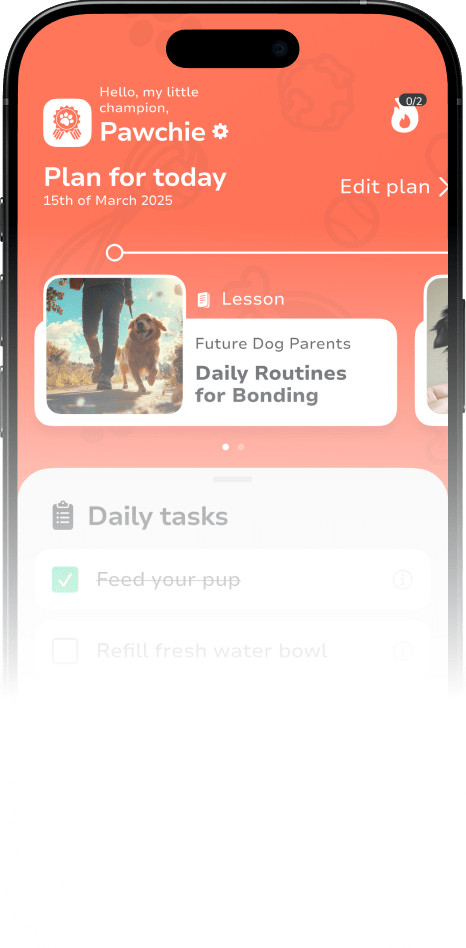
Medication is always a question for your licensed professional — but the daily behavior work that actually calms an anxious dog is where PawChamp earns its place. Everything in this guide, from gradual desensitization to rewarding the first flicker of calm, only works in small, correct, repeatable steps — and that's the hard part to get right alone. The app turns it into a structured plan, breaking dog separation anxiety training into tiny, achievable absences that lengthen only when your dog is ready, so you never accidentally push past the point of panic.
Because calm is built through repetition, daily routines and gentle reminders keep those short sessions consistent — the single biggest factor in whether desensitization sticks — while progress tracking reassures you, on rough days, that things really are trending the right way. And when you're unsure whether you're moving too fast or your dog is ready for more, the Ask a Dog Expert chat gives you a real person to check in with for the training side.
Bottom Line
Anxiety meds for dogs can be a valuable tool for some dogs, but they're never the whole answer — and they're always a decision for a licensed professional. The foundation of real, lasting calm is behavior work: routine, gradual training, and rewarding the calm you want to see. If something feels wrong with your dog, trust your instincts and reach out to a qualified professional.