The best dog training apps in 2026 do more than teach commands — they help owners work through real behavior challenges using positive reinforcement, with expert support when it's needed. We compared four popular options head-to-head.
Key Takeaways:
PawChamp — a comprehensive dog training and care app offering personalized programs and live chat with dog experts. It covers behavior, obedience, health, and everyday care across every life stage — puppies, adolescent dogs, adults, and seniors. It supports dogs from a wide range of backgrounds, from rescues to dogs with established behavioral challenges, and suits both first-time pet parents and experienced owners.
Woofz: A structured daily training focused primarily on puppies and newer dog owners. It combines step-by-step basic obedience and house-training programs with daily tasks and reminders designed to help users build and maintain a consistent routine.
Zigzag: A puppy-focused app built around a research-backed 12-week puppy development program. Its content concentrates on early socialization, foundational obedience training, and helping owners navigate the first months of puppyhood.
Pupford: A trainer-led platform offering a broad library of instructional videos and courses. Its content structure makes it accessible to owners who prefer to explore training materials independently and follow a self-guided approach.
Skip an app entirely if: your dog has a bite history, severe aggression, or extreme anxiety. See a certified veterinary behaviorist first.
How We Compared These Dog Training Apps?
Dog training apps in 2026 range from simple video libraries to personalized daily companions. The differences matter more than the marketing suggests — especially once an app needs to handle real behavior challenges apart from basic commands.
Every app in this guide was evaluated against five criteria:
Training methodology — does the app use positive reinforcement consistent with current behavioral science?
Scope — does it cover only obedience, or extend into behavior, health, and daily care?
Personalization — does the plan adapt to your specific dog, or does every user get the same path?
Expert access — is live support from certified trainers or behaviorists available in-app?
Pricing transparency — are trial terms and renewal expectations clear before you commit?
We also reviewed independent user feedback from Trustpilot, Reviews.io, App Store, Google Play, and Reddit communities to surface the patterns owners actually report after using each app.
Comparison Table (2026)
Prices and features change over time. Listed pricing serves as an example.
| App | Best For | Training Approach | Trainer Credentials | Price | Free Tier? | Limitations |
|---|---|---|---|---|---|---|
| PawChamp | All-life-stage training + behavior + health + daily care | Positive reinforcement | Strong (certified trainers + behaviorists + health specialists; IAABC-aligned) | Subscription from ~$9.99/week or ~$99.99/year. Free to download. | Yes (free download, paid features) | Subscription-only; best results require daily 10–15 min commitment |
| Woofz | Quick puppy basics + daily habit-building | Positive-leaning | Weak / unclear (trainer credentials not prominently disclosed) | Subscription from ~$12.99/week, ~$29.99/3 months, or ~$69.99/year | Limited | Fixed program structure; billing concerns most cited in independent reviews; less reliable for structured puppy development beyond basics |
| Zigzag | Structured 12-week puppy development | Positive reinforcement | Strong (certified behaviorists + pro trainers; University of Lincoln research partnership) | Free tier; Premium subscription typically ~$11.99/month or ~$79.99/year | Yes | Built specifically for puppyhood; less useful for adult dogs, rescues, or behavior work outside the 12-week structure |
| Pupford | Self-guided trainer-led video library | Positive reinforcement | Good (named trainers including Zak George; specific qualifications vary) | Free tier; Pupford Academy from ~$19/month or ~$147/year | Yes | Limited personalization; self-directed navigation; tech-dependent during real-time sessions |
Dog App Training Approach and Personalization
This is where the biggest gap between apps starts to show. A personalized dog training app should do more than ask whether your dog is a puppy or an adult. It should adjust based on behavior, progress, and what the owner actually needs help with.
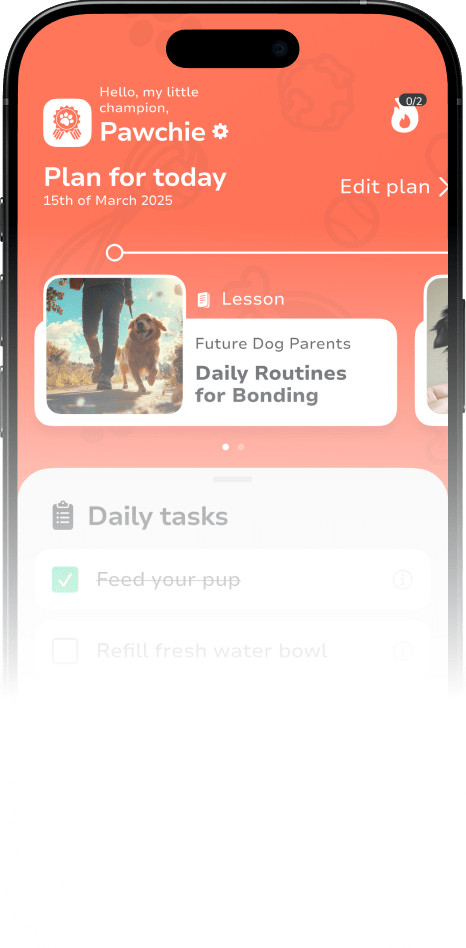
PawChamp is the strongest in this area. It is built around personalized plans, age-based learning paths, behavior support, and progress tracking. That makes it more useful for owners working on puppy basics, adult dog manners, or longer-term issues that need structure over time. Where most apps stop at obedience, PawChamp keeps going into the behavior work — reactivity, anxiety, resource guarding — that usually needs a plan built around one specific dog.
It also comes closest to what people expect from a dog behavior analysis app. It is not a medical tool, but it is more responsive to day-to-day behavior than a static content library.
That matters for owners looking for a reactive dog training app or a flexible best puppy training app. A puppy may need potty help now and leash skills later. A reactive adult dog may need a slower, more adaptive path instead of a fixed sequence.
💡 Tip:
The more behavior-specific the issue is, the more important personalization becomes. A generic plan is usually fine for sit. It is much less helpful for fear, reactivity, or overarousal.
Woofz offers structured paths, but the format feels more fixed once the plan is selected.
Zigzag is more tailored than a generic beginner app, and its daily lessons plus breed-aware puppy guidance are a real advantage for first-time owners. Still, Zigzag is much more focused on puppyhood, which makes it less naturally suited to adult dogs, rescues, or broader long-term behavior work.
Pupford offers a lot of useful content, but asks the owner to organize and apply it on their own.
User Experience and App Stability
A strong dog training app user experience matters more than people expect. Most owners are not using these apps at a desk. They are using them mid-walk, mid-session, or in the kitchen while trying to solve a problem in real time.
That means the app needs to be easy to navigate and practical in motion. Lessons should be quick to find. Instructions should be clear. The interface should not slow the session down.
This is also where dog training app video problems become relevant. If an app depends heavily on long videos or unstable playback, even good content becomes harder to use at the moment.
PawChamp has the advantage of providing video courses on popular topics. It is structured more like something you use during daily life than something you watch from the sidelines. You open it, do the short lesson it lines up for the day, and get on with things — there's no hunting through a library to work out what to practice. That suits people who train in quick bursts between everything else.
Pupford stands out here as well. Its content depth is a real strength, and many owners like the trainer-led video library. The tradeoff is that the experience depends heavily on video flow and self-directed consistency. If playback lags or the structure feels repetitive, the app becomes less useful during real training moments.
Woofz looks polished and easy to enter, but program-based products can feel heavier than they need to during short sessions.
Zigzag is cleaner and more guided for puppy owners, though it is still built around a narrower stage of dog ownership and is less useful once the dog’s needs move beyond early development.
What matters most in this category:
fast navigation during training;
stable video playback when video is needed;
clear lesson flow without too much clicking;
mobile usability with one hand;
quick access to next-step guidance.
These are simple things, but they often decide whether an app becomes part of a routine or gets abandoned.
Dog Training App Pricing, Subscriptions, and Transparency
Dog training app pricing is not just about cost. It is also about whether the trial, billing cycle, cancellation process, and renewals are clear before the user commits.
PawChamp, Woofz, Zigzag, and Pupford all use subscription-based models in different ways. That means users need to pay attention not only to the headline price, but also to how the plan renews and how easy it is to cancel.
Woofz is the clearest example of why subscription transparency matters. It is a popular app, but it is also the one most often linked with concerns around trial expectations, renewals, and billing confusion. That does not mean every complaint is valid. It does mean users should read the payment flow carefully before starting.
💡Tip:
Before starting any trial, take a screenshot of the plan, billing interval, and cancellation terms. Ten seconds now can save a lot of confusion later.
Zigzag is more straightforward in its positioning, but it is still a subscription-based product built around a defined puppy stage. That may feel reasonable for new owners, though it can be less appealing for people who want a broader long-term system.
That concern becomes even more relevant when people search phrases like dog training app charged without notice. Even when the issue comes down to missed renewal terms, it still affects how trustworthy a product feels.
A practical breakdown looks like this:
PawChamp — subscription model, better fit for owners who want an ongoing all-in-one system
Woofz — subscription-driven, but with more visible billing friction
Zigzag — subscription model limited for puppy owners and early-stage training
Pupford — lower entry barrier, but still built around paid layers inside a larger content ecosystem
Dog Training Results and Realistic Expectations
Online dog training results depend less on the app itself and more on whether the format helps the owner stay consistent long enough for the dog to learn.
That means dog training app effectiveness should be judged by outcomes, not just content volume.
Does the app help you train more often? Does it make the next step obvious? Does it still feel useful after the first week?
PawChamp — built for the long haul, not just handing over videos. Owners keep coming back because it always lines up the next step, so it still earns its place months in — whether the work is puppy basics or something harder like reactivity.
Woofz — works if you like being told exactly what to do next.
Zigzag — really for puppy owners who want a hand through the early weeks.
Pupford — great for self-starters who don't mind digging through a bigger library and building their own routine.
An app can teach the owner what to do. It cannot remove the complexity of the dog in front of them.
What apps can realistically do:
improve consistency;
teach owners better timing and structure;
support progress on common behavior goals;
help owners respond more calmly and clearly;
make daily training easier to maintain.
What apps cannot do:
guarantee the same results for every dog;
replace professional assessment in severe cases;
fix behavior without owner follow-through.
That last point matters. Good apps help. None of them is magic.
PawChamp Review
PawChamp app is the broadest app in this group — and the most useful one for owners who want a single tool covering training, behavior, health, and care across every life stage. Founded in 2022 as an online dog training school, the mobile app launched in January 2024 and now has over 500,000 users.
In everyday use, the appeal is low friction. Owners answer a few questions at the start, and the plan meets the dog where it actually is — not the same generic course handed to everyone. It stays that way over time: the plan keeps pointing to the next thing that matters for that particular dog, instead of a fixed list everyone works through in the same order.
What It Does Well
Comprehensive scope. Training, behavior, health, nutrition, and daily care in one personalized plan — not just obedience.
All life stages. Built for puppies, adult dogs, and seniors. Particularly strong for adult rescues and dogs with patchy training histories.
Live expert access. 24/7 chats with certified dog trainers and certified health and care specialists. The dual-expertise model is rare in the category.
Pawchie AI. A built-in AI assistant for everyday questions between expert chats.
Behavior coverage. Dedicated tracks for reactivity, separation anxiety, leash pulling, barking, jumping, and resource guarding.
Progress you can see. The plan tracks what you've worked on and adapts the next steps, so training feels like steady forward motion instead of a static checklist.
Methodology. Positive reinforcement, IAABC-aligned, developed with certified trainers and behaviorists.
Works in daily life. Short lessons owners can fit between everything else — a few focused minutes a day rather than long sessions to sit and watch.
Safe by design. Steers owners toward a certified professional for bite history, severe aggression, or extreme anxiety.
Tradeoffs
Subscription model. Owners who want a more focused puppy-only program may prefer Zigzag.
Best results require a daily 10–15 minute commitment.
Who Should Use PawChamp
Owners who want one app covering the full scope of dog ownership — and those working with behavior challenges, adult dogs, or rescues.
It's also a good fit for busy households that want structure without piecing together videos, blogs, and forums on their own.
The most effective way to start becoming a better owner is to download your personalized daily roadmap and follow the steps designed by behavioral experts.
Most owners see real change when they treat it as a daily ten-minute habit, not a one-time reference.
Woofz App Review
A clean, beginner-friendly app for new puppy owners who want guided programs with daily reminders.
What It Does Well
Polished consumer app. Smooth onboarding, easy to navigate.
Habit-building structure. Daily reminders and program-based learning paths.
Approachable for first-time owners. Doesn't overwhelm with content.
Solid puppy basics. Strong on early obedience and house training fundamentals.
Tradeoffs
Fixed program structure with limited flexibility once a path is chosen.
Billing concerns are the most consistent criticism in independent reviews.
Trial-to-paid transitions and auto-renewal terms have generated complaints on Trustpilot and elsewhere.
Weaker for adult dogs and complex behavior work.
Who Should Use Woofz App
New puppy owners who want a structured guided program with reminders.
Zigzag Puppy App Review
A research-backed puppy training app structured around a 12-week development plan. The University of Lincoln partnership is a genuine credentials story — and the app is built specifically for puppyhood.
What It Does Well
Research credentials. Partnership with the University of Lincoln gives Zigzag a research-backed credentials story.
Age and breed-based lessons. The plan adjusts to the puppy's age week-by-week and accounts for breed-specific tendencies.
12-week structured development. A clear roadmap from week one through the early socialization window and into adolescence.
24/7 expert support. Live access to dog trainers via in-app chat.
Tradeoffs
Puppy-locked structure. Built around the first weeks of life; less useful for adult dogs and rescues.
Limited scope outside of training — does not cover health, nutrition, or daily care.
Subscription required for full Premium content.
Who Should Use Zigzag
First-time puppy owners who want a clear, research-backed daily roadmap.
Pupford Review
Quick take
A content library, not a personalized plan. The free tier is genuinely useful, and the trainer-led video content is well-produced. You'll do the organizing yourself.
What It Does Well
Wide content library. Hundreds of trainer-led video lessons across topics.
Real free tier. Substantial content available without paying.
Recognized trainers. Named contributors with credentials in the dog training world.
Good entry point. Useful for browsing before committing to any paid app.
Tradeoffs
Self-directed navigation — you decide which content to follow and when.
Less helpful for newer owners who don't yet know what to search for.
Video-heavy formats can lag in low-connectivity moments.
No personalized adaptive plan.
Who Should Use Pupford
Self-guided learners with specific goals who want a broad video library.
How Positive Reinforcement Dog Training Actually Works?
All four apps use positive reinforcement as their stated foundation. Here's what that means in practice.
Positive reinforcement = marking and rewarding the behavior you want repeated, consistently enough that the dog connects the action to the outcome. Treats, praise, play. Not punishment, not corrections, not dominance framing.
It's the approach endorsed by the IAABC, the APDT, and the AVSAB — the leading professional bodies in applied animal behavior.
For basic obedience — sit, stay, recall — the differences across apps are minor.
For behavior challenges — reactivity, fear, anxiety, overarousal — methodology depth matters much more. These issues need specific protocols (threshold management, counter-conditioning, gradual exposure) and benefit from expert feedback. That's where in-app trainer access becomes more valuable than a content library alone.
❌ When an app isn't enough
If your dog has bitten someone, shows severe anxiety, or displays aggression that feels unsafe, a certified veterinary behaviorist should be the first call. Apps can support daily practice; they can't replace professional assessment for these cases.
Best Dog Training Apps: Pros and Limits
Online dog training results depend less on the app and more on whether the format helps you stay consistent long enough for the dog to learn.
Apps reliably help with:
Building daily training habits through structure and reminders
Better timing, technique, and reading of your dog
Common behavior goals — leash pulling, barking, jumping, recall
Connecting owners to expert guidance when needed
Apps cannot:
Guarantee identical results across every dog
Replace in-person professional help for serious aggression, severe anxiety, or bite histories
Work without owner consistency
Dog behavior does not change overnight. What looks like stubbornness is usually a dog who doesn't yet understand what's being asked — or one who hasn't been given enough practice. Small consistent steps compound. Ten minutes a day beats an hour once a week.
Dog Training App Review: Bottom Line
If you want one app that covers training, behavior, health, and daily care across every life stage — with real expert access when you need it — PawChamp is the most complete option in this comparison. If you want a simple guided program for a new puppy, Woofz is a straightforward starting point. If you want a research-backed structured puppy development plan, Zigzag. If you prefer self-guided learning from a broad library, Pupford. All four can teach a dog to sit. The differences show up in what happens after that.