The first night home with a new puppy can feel like a never-ending loop of whimpers, wake-ups, and bleary-eyed stumbles to the kitchen. Sound familiar? Here's the reassuring truth: your puppy can learn to sleep through the night — and it happens faster than most owners expect when you follow a plan that matches their age and development stage.
Key Takeaways
- Most puppies can sleep 6–8 hours straight by 12–16 weeks of age when given a consistent nighttime routine.
- Sleep consolidation is a biological milestone — pushing it too fast leads to setbacks, so matching expectations to your puppy's age is essential.
- A predictable pre-bed routine (last meal timing, a final potty trip, calm wind-down) is the single biggest factor in faster sleep consolidation.
- Week-by-week progress is realistic and measurable — small, consistent steps beat dramatic overnight fixes every time.
- PawChamp's personalized sleep and training plans help you stay on track through every milestone, right from your phone.
Why Puppies Wake Up at Night — and When It Gets Better
Before diving into the weekly plan, it helps to understand why puppies struggle to sleep through the night in the first place. It comes down to three overlapping factors: a tiny bladder, an undeveloped circadian rhythm, and the novelty of being away from their littermates for the first time.
Newborn puppies sleep in short bursts around the clock. By the time they reach you at 8 weeks, their sleep-wake cycles are still loosely organized — they haven't yet learned that night means long sleep and day means activity. That biological calibration takes time, but your routine speeds it up dramatically.
Bladder capacity is the other limiting factor. At 8 weeks, most puppies can hold their bladder for roughly 2–3 hours overnight. By 12 weeks that stretches to 4–5 hours, and by 16 weeks many can manage 6–8 hours — the threshold most owners consider "sleeping through the night." If you want a deeper look at how much rest your pup actually needs at each age, check out this guide on how much sleep a puppy needs by age — it puts the overnight stretches in context of total daily sleep.
The key insight: sleep consolidation is a developmental milestone, not just a training outcome. You can't rush a puppy's bladder, but you can build an environment and routine that makes every night incrementally better.
Why Puppies Wake Up at Night — and When It Gets Better
🧠 Think About:
Many owners assume nighttime waking is always a behavior problem. In young puppies under 10 weeks, it's almost always biological — a need to eliminate or a developmental sleep stage. Treating it as bad behavior and ignoring it can backfire; responding calmly and briefly is the right move at this age.
Before You Start: Setting Up for Sleep Success
No week-by-week plan works without the right foundation. These are the non-negotiable setup steps that make everything else click into place.
Choose a Consistent Sleep Spot
Your puppy should sleep in the same location every night. Whether that's a crate, a puppy pen, or a designated dog bed in your bedroom, consistency is what matters. The sleep spot should feel predictably safe — familiar scent, comfortable bedding, and low stimulation.
Time the Last Meal and Water
Feed your last meal of the day 3–4 hours before bedtime, and pick up the water bowl 1–2 hours before lights out (while making sure your puppy is well-hydrated during the day). A full belly right before bed almost guarantees a midnight bathroom run.
Engineer a Wind-Down Window
The 30–45 minutes before sleep should be deliberately calm: dim lights, quiet voices, gentle petting — no fetch, no tug, no excited visitors. This signals to your puppy's nervous system that the active part of the day is ending. Think of it as a puppy version of a bedtime routine.
Always End with a Potty Trip
The very last thing before you put your puppy down for the night is a final potty outing. Keep it boring and functional — no play. Walk them to the spot, wait, reward calmly when they go, and head straight back inside. This one step alone can extend the first overnight stretch by 30–60 minutes.
Week 1–2: The Arrival Phase (8–10 Weeks)
These first two weeks are about survival mode — yours and your puppy's. Realistic goal: one 3-hour stretch of unbroken sleep overnight. That's it. Anything more is a bonus at this age.
Your puppy has just left everything familiar: their mother, their littermates, the sounds and smells of their birth environment. Sleep will be fragmented, and that is completely normal. Your job right now is to establish the routine skeleton, not to enforce long sleep stretches.
What to Do Each Night
- Follow the wind-down window and final potty trip.
- Place your puppy in their sleep spot with a worn item of your clothing for comfort.
- Set an alarm for 2.5–3 hours after bedtime for a proactive potty trip — taking them out before they cry is better than waiting for a wake-up.
- Keep overnight potty trips brief and boring: no eye contact, no excited voice, no play. Lights low, straight to the potty spot, straight back to bed.
- Log the wake-up times each night so you can spot patterns forming.
Consistency during these two weeks is everything. The routine you build now becomes the template your puppy's brain maps onto nighttime for weeks to come.
📌 Example:
A Golden Retriever owner sets their alarm for 2:30 AM after a 10:00 PM bedtime. The puppy barely stirs during the trip, eliminates quickly, and goes straight back to sleep. By night five, the puppy is staying quiet until the alarm — no crying at all. That's the proactive approach working perfectly.
Week 3–4: Building the Stretch (10–12 Weeks)
By week three, your puppy has had 14+ nights inside a routine. Their nervous system is starting to associate the wind-down cues with sleep, and their bladder is growing. Realistic goal: a 4–5 hour first stretch overnight.
This is the week you can begin gradually pushing the overnight potty trip later. If your puppy has been consistently quiet until your 2:30 AM alarm, move it to 3:00 AM. If that holds for two nights, push to 3:30 AM. This incremental approach trains the bladder gently and avoids accidents that would set your timeline back.
Introduce a Sleep Cue
Add a simple, consistent verbal cue right as you place your puppy in their sleep spot — something like a soft "settle" or "bedtime." Pair it with a small, calm reward (a lick mat with a little peanut butter or a single treat). Over a few nights, this phrase becomes a sleep signal that your puppy's brain starts to associate with the onset of a long rest period.
Handle Night Whining Strategically
If your puppy wakes and whimpers before the scheduled potty time, wait 2–3 minutes before responding — many puppies settle back down on their own. If the whining escalates, respond calmly, take them out briefly, and return without fuss. At this age, whining that suddenly appears mid-stretch is almost always a genuine bathroom need, not a manipulation tactic. Treat it accordingly.
Puppies experiencing a lot of nighttime restlessness may also be processing daytime overstimulation. If you're dealing with a puppy who's nippy and wound up during the day too, you might find the approaches in this guide on managing puppy biting week by week helpful — tired, overstimulated puppies are harder to settle at night.
Week 5–6: Consolidation Begins (12–14 Weeks)
At 12 weeks, something shifts. Most puppies show a noticeable improvement in sleep quality around this milestone — their circadian rhythm is stabilizing, their bladder can hold longer, and the routine has become genuinely predictable. Realistic goal: 5–6 unbroken hours overnight, with many puppies hitting 6+ by the end of week six.
This is when you can begin eliminating the proactive overnight potty alarm for some puppies. If your puppy has gone three consecutive nights without waking before 5:00 AM, try skipping the alarm and letting them self-regulate. Keep a close ear out — if they wake and signal within a few minutes, respond promptly. Accidents at this stage are almost always a timing issue, not a regression.
Fine-Tune the Daytime Schedule
Overnight sleep quality is downstream of daytime structure. At 12–14 weeks, your puppy should be getting 3–4 naps during the day, the last one ending at least 2 hours before bedtime. A puppy who naps too close to bedtime won't be tired enough to settle quickly. Equally, a puppy who is overtired and overstimulated heading into bed will be harder to settle — look for the calm-but-sleepy window.
Shift Bedtime if Needed
If your puppy is waking consistently at 5:30 AM regardless of when you put them down, that's likely their natural morning wake time — not a problem you can train away entirely. Working backward from that time, a 10:00–10:30 PM bedtime is typically the sweet spot for a 12-week-old aiming for a 6-hour stretch. Adjust your household schedule to match, rather than fighting the puppy's biology.
🐾 Fun Fact:
Some breeds consolidate nighttime sleep faster than others. Breeds bred for calm companionship — like Cavalier King Charles Spaniels and Basset Hounds — often settle into longer stretches earlier. High-energy working breeds like Border Collies and Australian Shepherds may take a week or two longer, partly because they need more daytime activity to truly tire out.
Week 7–8: Reaching Full Sleep-Through (14–16 Weeks)
By weeks seven and eight, most puppies are physiologically and behaviorally ready to sleep through the night — typically defined as 6–8 hours without a potty break. This is the consolidation phase where everything you've built pays off.
If your puppy is still waking once overnight at 14 weeks, that's not a failure — it's the trailing edge of normal development. Continue pushing the overnight window by 15–20 minutes every two to three nights. Most puppies close that final gap within this two-week window.
What "Sleeping Through the Night" Actually Looks Like
Be realistic about expectations. A 15-week-old puppy sleeping from 10:30 PM to 5:30 AM — that's 7 hours — is sleeping through the night by any sensible definition, even if that doesn't match your own sleep schedule perfectly. The goal isn't to match a human adult's 8–9 hour cycle; it's to reach a point where overnight interruptions are gone.
When to Suspect a Non-Routine Issue
If your puppy has regressed after progressing, or consistently wakes despite following the plan precisely, consider these possibilities:
- Growth spurts — brief regressions around developmental leaps are common and self-resolving.
- Environmental disruption — a change in the sleep space, a new family member, or household noise can temporarily derail progress.
- Health issues — a puppy waking urgently and frequently may have a urinary tract issue; consult your vet if frequency suddenly increases.
- Insufficient daytime exercise — a physically under-stimulated puppy has excess energy that surfaces at night.
Understanding whether your puppy is sleeping too much or showing other unusual sleep patterns during the day can also give you useful context — this overview of why dogs sleep so much and when it's a concern is worth a read if anything seems off.
💡 Tip:
Keep a simple notes app log during the consolidation phase: bedtime, any wake-ups, potty success, and wake time. Looking back across 10–14 days of data almost always reveals a clear pattern — and that pattern tells you exactly what to adjust next. Many owners are surprised to find their puppy is actually making steady progress that isn't obvious night-to-night.
Common Mistakes That Stall Nighttime Progress
Even well-intentioned owners can inadvertently slow sleep consolidation. Here are the most frequent stumbling blocks:
- Inconsistent bedtime: Putting your puppy down at 9 PM some nights and midnight on others prevents the circadian rhythm from anchoring. Pick a time and protect it, even on weekends.
- Responding to every sound: Brief, self-settling whimpers at 12–14 weeks are developmentally normal. Rushing in at every noise teaches your puppy that vocalizing produces company — the opposite of what you want at 2 AM.
- Exciting the puppy during overnight potty trips: Any play, praise, or bright light during a nighttime bathroom run signals "this is activity time." Keep it purposely dull.
- Skipping the wind-down: High-energy play right before bed leaves the nervous system in a revved state. The wind-down window isn't optional — it's the bridge between day and sleep.
- Moving the sleep spot too often: Location consistency is part of the sleep cue. Moving a puppy between the bedroom and another room, or between a crate and a bed, creates unpredictability that slows progress.
How Can PawChamp Help?
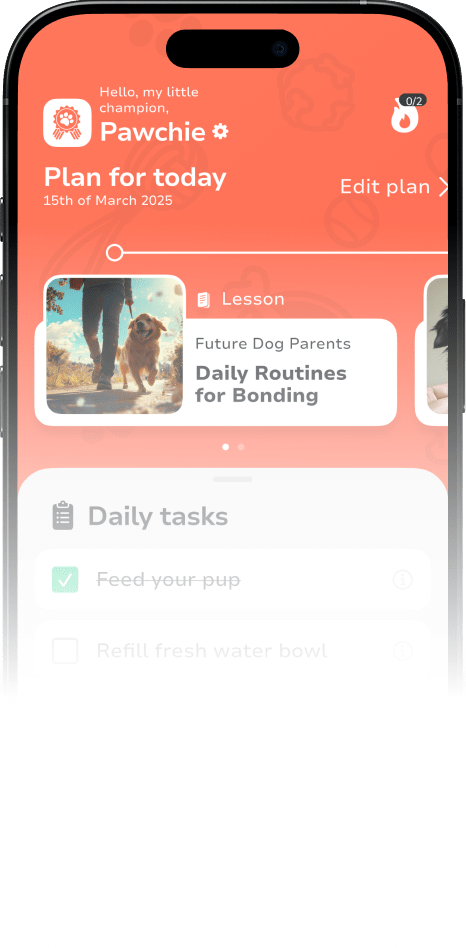
PawChamp takes the guesswork out of puppy sleep training by giving you a structured, personalized plan built around your puppy's exact age and breed.
- Personalized week-by-week plans: PawChamp generates a sleep and routine plan matched to your puppy's current developmental stage, so you're never working from a one-size-fits-all schedule that doesn't fit your dog.
- Expert-verified lessons: Every sleep training technique inside the app has been reviewed for accuracy and humane practice, so you can follow the steps with confidence.
- In-app expert chat: When your plan hits a snag — a sudden regression, an unusually early morning waker, a puppy who just won't settle — you can reach a Dog Training Expert or Dog Health and Care Expert directly inside the app for real, specific guidance.
Whether you're on night three with a bewildered 8-week-old or pushing for that final overnight stretch at 15 weeks, PawChamp gives you a knowledgeable guide in your pocket every step of the way.
Bottom Line
Most puppies can learn how to sleep through the night by 14–16 weeks when owners follow a consistent, age-appropriate routine rather than expecting overnight miracles. The week-by-week approach works because it respects your puppy's biological milestones — gradually extending the overnight stretch as bladder capacity and circadian rhythm develop together. Stay consistent with your wind-down routine, keep overnight potty trips calm and brief, and trust the process: steady progress beats dramatic fixes every single time.