Your brand-new puppy is home, and life is equal parts adorable and painful — literally. Those needle-sharp teeth are latching onto your hands, ankles, and favorite hoodie with impressive enthusiasm. Here's the truth: biting is completely normal puppy behavior, but that doesn't mean you're stuck with it. With a clear, week-by-week roadmap that respects where your puppy is developmentally, you can dial down the biting — and do it without squashing that wonderful puppy confidence you worked so hard to bring home.
Key Takeaways
- Puppies bite to explore, teethe, and practice social skills — it's developmentally normal from 8–20 weeks.
- Teaching bite inhibition (soft mouth) comes before teaching "no biting at all."
- Consistent redirection, calm timeouts, and impulse-control games are the three pillars of success.
- Each week brings new cognitive ability — matching your training to your puppy's developmental stage gets faster results.
- PawChamp gives you a personalized, age-matched plan so you always know exactly what to work on next.
Why Puppies Bite — and Why It Actually Matters
Before you can stop something, you need to understand why it's happening. Puppies use their mouths the way human toddlers use their hands — to investigate textures, test cause-and-effect, and communicate. In the litter, mouthing is how pups learn bite inhibition: a littermate yelps, play stops, and the biter discovers that hard bites end the fun.
When puppies arrive in human homes, they lose that instant feedback loop — unless we deliberately recreate it. Skipping the "soft mouth" phase and jumping straight to "zero biting" can backfire: a dog who was never taught bite pressure control may one day bite hard accidentally because the lesson was never embedded.
According to the American Kennel Club, mouthing and nipping are expected puppy behaviors that owners can manage effectively with consistent positive reinforcement — the goal is to shape the behavior, not suppress the dog's curiosity or drive.
Understanding why your puppy bites also tells you what to fix first. Is it excitement during play? Frustration when you stop petting? Teething discomfort? Overstimulation? Each cause calls for a slightly different response, and that's exactly what the week-by-week plan below addresses.
Why Puppies Bite — and Why It Actually Matters
🧠 Think About:
A puppy that bites hard during play isn't being "dominant" or "bad." It simply hasn't learned the rules of human play yet. Your job is to be the clearest, kindest teacher it has ever had.
Weeks 8–10: Laying the Foundation for a Soft Mouth
Your puppy just arrived. Its brain is a sponge, but its attention span is roughly the length of a commercial break. This is the perfect window to introduce the concept that teeth on skin = all fun stops.
What to Do
- The yelp method: When teeth touch skin, let out a short, high-pitched "ouch!" and immediately go limp and still. Wait two seconds, then resume play. If biting continues, stand up and turn your back for 10–15 seconds. This mimics littermate feedback.
- Redirect to a toy: Keep a tug toy or chew toy within arm's reach at all times. The moment you feel teeth, swap your hand for the toy. Say "get your toy" in a cheerful voice — you're teaching a replacement behavior, not just blocking one.
- Manage energy peaks: Most biting blitzes happen when puppies are overtired or overstimulated. Track your puppy's sleep — 8-week-olds need 16–18 hours a day. Proactively crate them before they hit the "zoomies-and-bite" wall.
What to Avoid
Never push your puppy's face away, tap their nose, or yell — these create confusion, fear, or worse, escalate excitement. Stick to calm, consistent withdrawal of attention. Puppies crave your engagement more than anything, so removing it is the most powerful signal you have.
Check out these proven tips to stop puppy biting fast for a quick-reference guide you can keep on your phone during those first hectic days.
💡 Tip:
Carry a small tug toy in your pocket during weeks 8–10. The faster you can redirect, the faster your puppy learns which object gets the fun going again.
Weeks 11–13: Adding Impulse Control to the Mix
By week 11, your puppy's brain has developed enough to begin learning basic impulse control — the mental skill that underlies every polite behavior, including not biting. This is the phase where you go from "biting stops play" to "waiting calmly starts play."
Introduce "Leave It" and "Settle"
Teaching "leave it" with treats in your closed fist is a natural segue to bite control: the same self-restraint muscle that says "I won't grab that treat" starts to say "I won't grab that hand." Work in 2–3 minute sessions, three times a day.
"Settle" — asking your puppy to lie down calmly on a mat — is your secret weapon for winding down arousal before it spills into biting. Reward four paws on the mat and a relaxed body with calm praise and a treat. Keep sessions short and end before your puppy checks out.
Structured Play Rules
- You initiate and end all games — this teaches your puppy that calm behavior is what unlocks the fun, not pestering.
- Use a clear "game on" cue (e.g., "ready?") and a "game over" cue (e.g., "all done") so your puppy can predict transitions.
- Rotate toys to keep novelty high — a bored puppy is a bitey puppy.
Progress Check
By the end of week 13, most puppies show noticeably softer mouthing pressure than at week 8. If you're still seeing hard, painful bites with no sign of improvement, that's a cue to look at arousal triggers, sleep schedule, and whether all family members are applying the same rules consistently.
Weeks 14–16: Raising the Bar — Less Mouthing, More Manners
This is the phase where you shift the goalposts. Up until now, softer biting was the win. Now the goal becomes no teeth on skin at all during calm interactions, while keeping teeth-on-toy perfectly acceptable during structured play.
Refine the Timeout Technique
If a brief social withdrawal in weeks 8–10 was a soft consequence, a proper brief timeout now sends a clearer signal. The moment teeth touch skin:
- Say "oops" in a neutral tone — no drama.
- Stand up, step behind a baby gate or into a room, and close the door for 20–30 seconds.
- Return calmly. If the puppy immediately bites again, repeat.
Consistency across every person in the household is non-negotiable at this stage. One family member who lets biting slide during "just playing" undoes a week of everyone else's work.
Introduce Polite Greeting Behaviors
Many biting incidents happen at the moment of greeting — when your puppy is most excited to see you. Teach an incompatible behavior: four paws on the floor earns your attention; jumping or mouthing makes you turn away. Layer this with a sit at greetings once your puppy has a reliable sit.
Teething Awareness
Puppies typically begin losing baby teeth between 12 and 16 weeks, with the process completing around 6 months. During active teething, chewing needs spike dramatically. Frozen Kongs, chilled carrots, and rubber chew toys give sore gums appropriate relief — reducing the urge to chew on you.
🐾 Fun Fact:
Puppies have 28 baby teeth that are eventually replaced by 42 adult teeth. That's a lot of mouth activity happening between weeks 12 and 24 — so having plenty of appropriate chew options isn't a luxury, it's a necessity.
Weeks 17–20: Solidifying the Habit and Generalizing to New Situations
By 17 weeks, the foundation is solid — now it's time to proof the behavior across different environments, people, and excitement levels. A puppy who doesn't bite at home but nips at a guest or on a walk still has work to do.
Generalization: New People, New Places
Introduce controlled meet-and-greets where you coach visitors in advance: "If he mouths your hand, just freeze and turn away." Hand each visitor a treat to reward a calm, mouth-closed greeting. Set your puppy up to succeed by doing a short exercise session before guests arrive — a tired puppy is a polite puppy.
Threshold Management on Walks
Leash biting and ankle nipping during walks often spike at this age because movement triggers prey drive and frustration. If your puppy starts targeting the leash or your feet:
- Stop moving immediately — movement is the reward; stillness removes it.
- Ask for a sit or eye contact, reward, then move again.
- Use a slightly longer leash (4–6 ft) so your puppy has room to walk beside you without feeling pressured.
When Biting Resurges
A brief regression around 16–20 weeks is common during the second teething phase and adolescence creeping in early. Don't panic and don't escalate consequences — simply return to the foundations: redirect, withdraw attention, reward calm behavior. The pattern is still there; it just needs reinforcing.
If you're navigating a particularly persistent biter, the fastest techniques for stopping puppy biting can help you troubleshoot which step in the chain might be breaking down.
📌 Example:
A 19-week-old Golden Retriever starts leash-biting every time his owner speeds up on a walk. The owner stops, waits for stillness, asks for eye contact, then rewards and moves again. Within three sessions, leash biting drops by 80% — because the dog learns that biting stops movement, but calmness earns it.
How Breed and Temperament Affect Your Timeline
Not every puppy follows the same arc, and breed tendencies play a real role. Herding breeds like Border Collies and Australian Shepherds often have a higher nipping drive linked to instinctive herding behaviors — heel nipping and ankle chasing can persist longer and require more dedicated threshold work. Retriever breeds like Labrador Retrievers and Golden Retrievers typically have a naturally softer mouth from generations of selective breeding, which can make the process faster — but their enthusiasm during play means redirection still needs to be consistent. Terrier breeds are tenacious and high-energy; they respond especially well to structured play with clear rules because they love to win games.
Temperament matters as much as breed. A bold, high-drive puppy needs more impulse-control exercises and shorter, more frequent sessions. A softer, more sensitive puppy may need a gentler yelp cue and extra positive reinforcement around the mouth to avoid creating hand-shyness. Observe your individual dog and adjust — the week-by-week timeline is a guide, not a rigid script.
How Can PawChamp Help?
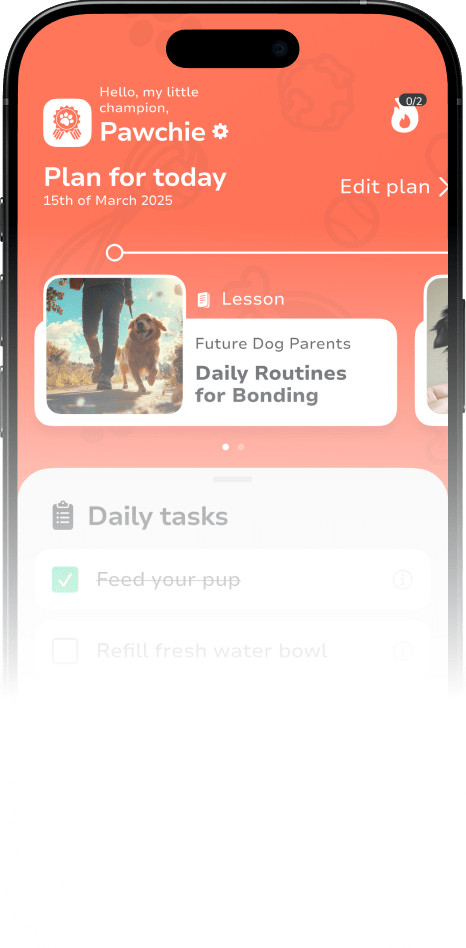
PawChamp takes the guesswork out of puppy training by meeting you exactly where your puppy is developmentally — no generic advice, no one-size-fits-all schedules.
- Personalized weekly plans: The app builds a training roadmap matched to your puppy's age, breed, and temperament — so you always know what to work on this week, not what worked for someone else's dog six months ago.
- Expert-verified bite inhibition lessons: Every lesson in the app is reviewed for accuracy and humane technique, so you can follow along confidently without second-guessing the method.
- In-app expert chat: Got a question about a regression or a stubborn nipping habit? Connect directly with a Dog Training Expert or a Dog Health and Care Expert inside the app for real, personalized guidance.
Whether you're on week 9 wondering if the yelp method is working or on week 19 dealing with an adolescent regression, PawChamp keeps you moving forward with a plan that actually fits your puppy.
Bottom Line
Learning how to stop a puppy from biting is a gradual process that works best when you respect your puppy's developmental stage — starting with bite inhibition in weeks 8–10, layering impulse control through weeks 11–16, and generalizing good manners in weeks 17–20. Consistency across every person in your household, plenty of appropriate chew outlets, and calm but firm consequences are the three things that make the biggest difference. Stick with the plan, celebrate small wins, and remember that every puppy who learns to keep teeth off skin does so because someone was patient enough to teach them.