One second your dog is trotting politely beside you — the next, a flash of grey fur shoots across the path and your leash is nearly ripped from your hand. Sound familiar? Squirrel chasing (and the pursuit of rabbits, birds, and cats) is one of the most frustrating — and genuinely dangerous — behaviors dog owners face. The good news: it is absolutely trainable, but it requires understanding why the chase feels so irresistible to your dog before you can reliably interrupt it.
Key Takeaways
- Squirrel chasing is driven by a hard-wired predatory motor sequence — suppressing it takes specific counter-conditioning, not just "no."
- A long line keeps your dog safe while you build the skills needed for off-leash reliability.
- Your interrupt cue (a recall or "leave it") must be trained at low distraction first and proofed gradually up to prey-level stimuli.
- Predatory drift — the moment play escalates into serious prey drive — is a key safety concept for multi-pet homes.
- Consistency across all walks, family members, and environments is what turns a good training session into real-world behavior change.
Understanding Predatory Drift and Prey Drive
Before you can teach your dog to ignore a squirrel, you need to understand what is happening in their brain the moment they spot one. Dogs retain a predatory motor sequence inherited from wolves: orient → stalk → chase → grab → kill → dissect. Most domestic dogs have had parts of this sequence selectively suppressed through breeding — a Border Collie, for instance, has an amplified "stalk and chase" but a reduced "grab-kill." A terrier may have a turbo-charged "grab" phase. Knowing your dog's breed tendencies tells you how intense the drive is likely to be.
Predatory drift is a specific, important concept: it describes the moment when a dog that is already aroused — perhaps playing roughly or reacting to movement — suddenly "tips over" from social behavior into genuine predatory behavior. This is why a dog that lives peacefully with a cat indoors can suddenly chase that same cat if the cat bolts unexpectedly across a yard. The movement triggers the sequence. Understanding this helps you manage multi-pet households safely and set up training scenarios that don't accidentally push your dog over threshold.
Prey drive is not a character flaw — it is a deeply reinforcing, neurologically driven behavior. The chase itself releases dopamine. That means the squirrel is not even the reward; the pursuit is. This is why yelling "no" mid-chase rarely works: your dog is essentially mid-roller-coaster, flooded with feel-good neurochemicals and completely unable to process a verbal cue.
Understanding Predatory Drift and Prey Drive
🧠 Think About:
High prey drive is not the same as aggression toward people. A dog that goes bananas chasing squirrels can still be a gentle, social family dog — the two systems are largely separate. Keep that in mind so you approach training with curiosity rather than alarm.
Why Your Current Recall Fails Around Squirrels
Most owners have a perfectly functional recall — right up until a squirrel appears. The problem is proofing, or rather the lack of it. A recall taught in the living room or a quiet backyard has been rehearsed against very low distraction. A squirrel in motion is, neurologically speaking, one of the highest-value distractors a dog can encounter. You are asking your dog to choose you over a dopamine hit — and you haven't yet made yourself worth that trade.
There is also a phenomenon called trigger stacking: if your dog has already been stimulated by smells on the walk, saw a cyclist, and heard a dog bark, their arousal level is already elevated before the squirrel even appears. By the time the squirrel runs, they tip into chase mode almost instantly. Tracking your dog's cumulative arousal on a walk is just as important as the squirrel-specific training itself.
If your dog also reacts to other dogs on walks, the same proofing principles apply — you can read more about managing on-leash reactivity to other dogs to see how threshold work and interrupt cues transfer across different triggers.
📌 Example:
Imagine your dog rates a biscuit at 5/10 and a tennis ball at 7/10. A squirrel in motion might be 10/10. Your treat reward needs to feel like an 11/10 to compete — think tiny pieces of real chicken, cheese, or hot dog, reserved only for high-distraction work. Save the kibble for the sofa.
Setting Up Safe Long-Line Work
A long line — typically a 15- to 30-foot lightweight leash — is the single most important piece of equipment for squirrel-chasing training. It gives your dog enough freedom to make choices while ensuring they cannot get injured or injure a small animal. Never use a retractable leash for this work; the constant tension removes your control and the locking mechanism can fail at exactly the wrong moment.
How to Use a Long Line Safely
- Attach to a harness, not a collar, to protect your dog's neck if the line goes taut suddenly.
- Let the line trail loosely on the ground — only pick it up and hold on if your dog has already begun orienting toward prey.
- Never wrap the line around your hand or wrist; a 40-pound dog at full sprint can generate enough force to injure you.
- Use open fields or quiet parks where the line won't tangle in other people's legs or around trees at critical moments.
The long line buys you the ability to interrupt the chase before it self-rewards. The moment your dog sprints after a squirrel and catches it (or even gets close), the predatory motor sequence gets reinforced. Preventing the completion of the sequence, then redirecting to you, is the training loop you want to build.
Building an Interrupt Cue That Can Compete With Prey
An interrupt cue is any trained signal — a word, a sound, your dog's name — that reliably pulls your dog's attention back to you. The most effective for prey-chasing scenarios is a conditioned emotional response recall: a unique word (many trainers use "yes!" or a whistle) that has been classically conditioned to mean "extraordinary things are about to happen to me." Here is a step-by-step framework:
Phase 1: Build the Association Indoors
Say your chosen cue word once, then immediately deliver a high-value treat — no sit, no wait, no other behavior required. Repeat 20–30 times over several sessions. The goal is pure Pavlovian association: cue → jackpot. Your dog should start to visibly brighten and orient to you the moment they hear the word.
Phase 2: Proof at Low Distraction Outdoors
Move to the garden or a quiet street. Practice the cue while your dog is sniffing, mildly distracted, or moving away from you. Each successful response earns a genuine jackpot — multiple small treats delivered one at a time, with enthusiastic praise. Keep sessions under five minutes to maintain intensity.
Phase 3: Add Distance and Controlled Distraction
On the long line, let your dog drift to the end of the line exploring. Fire the cue. The moment they begin to turn toward you, back up quickly — your movement away from them triggers their chase instinct in your favor. Reward massively when they reach you. Gradually introduce mild distractions (a toy on the ground, a known calm dog nearby) before ever attempting real squirrel scenarios.
Phase 4: Work at Threshold Near Real Prey
Find a park where squirrels are present but at a distance your dog can notice without locking on. The distance at which your dog can look at a squirrel without going over threshold is called the threshold distance. Work your interrupt cue repeatedly at this distance. Over sessions — not days, but weeks — you will find that threshold distance shrinks as your dog learns that orienting to you pays better than chasing.
💡 Tip:
Never call your dog away from a squirrel and then end the walk. If coming to you always means "fun is over," your recall will deteriorate fast. Instead, reward, have a quick game with a toy, then release your dog to sniff again. You want your dog to believe that responding to you is the beginning of more good things, not the end of them.
Desensitization and Counter-Conditioning in Practice
Desensitization means gradually exposing your dog to the sight or smell of small animals at a level low enough that they remain calm — then very slowly decreasing the distance or increasing the intensity over many sessions. Counter-conditioning means pairing that stimulus with something your dog loves, so the emotional response shifts from "I must chase!" to "Oh, squirrel means cheese appears!" Used together, they are the gold standard for prey-drive management.
A practical setup: sit on a park bench at a distance where squirrels are visible but your dog is relaxed. Every time your dog glances at a squirrel and then looks back at you — even voluntarily — deliver a treat and calm praise. You are reinforcing the disengagement, not just the looking-at-squirrel. Over time, this builds a default behavior: see squirrel, check in with owner.
Crucially, never push the distance too quickly. If your dog lunges, stiffens, or fixates hard on the squirrel, you are over threshold and no learning is happening — only the predatory motor sequence is running. Step back to a greater distance and restart. This patient, below-threshold approach is the same framework used to help dogs who bark and lunge at other dogs on walks, and it transfers beautifully to squirrel work.
🐾 Fun Fact:
Scent hounds and terriers were specifically bred to follow and flush small, fast-moving animals. If you have a Beagle, Jack Russell Terrier, or Dachshund, expect prey drive training to take longer — and celebrate every small win. Their instincts run very deep, which makes each successful interrupt cue a genuine achievement.
Managing Multi-Pet Homes and Predatory Drift
If you have a dog and a cat — or a dog and a rabbit, guinea pig, or bird — predatory drift is a real safety consideration. Even a dog that has coexisted peacefully with a small animal for years can be triggered by sudden movement, high-pitched sounds, or an already-aroused state. Practical management steps include:
- Never leave your dog and small pets unsupervised, even after years of calm coexistence.
- Keep arousal low before interactions — don't let your dog come in from a high-energy play session and immediately greet a cat.
- Teach a solid "leave it" with the small pet as the distraction, built up gradually under controlled conditions.
- Provide the small pet with escape routes — elevated spaces, baby gates — so they are never cornered.
The goal in a multi-pet home is not to suppress your dog's prey drive completely (which is neither realistic nor fair), but to manage the environment and build reliable trained behaviors that give you the ability to interrupt a drift before it escalates.
Consistency, Generalization, and Real-World Proofing
One of the biggest reasons interrupt cues fail in the real world is a lack of generalization. A cue that works beautifully with your trainer present, in a familiar park, on a Tuesday morning, may fall apart on a Saturday afternoon in a new location with two squirrels and a jogger. This is normal dog learning — dogs are context-specific — but it means you need to deliberately practice in varied environments, with varied handlers, and at varied times of day.
Make sure every adult in the household uses the same cue word, the same reward delivery, and the same rules. If one family member lets the dog lunge and laughs it off, your training is being partially undone on every walk they take together. Consistency is not about being strict — it is about giving your dog a clear, predictable picture of what pays off.
Track your progress honestly. If after eight weeks of consistent work your dog still cannot orient to you within two seconds of hearing the cue at a squirrel-present park, it may be time to consult a professional — a certified positive-reinforcement trainer who can observe the specific dynamics of your dog's arousal and response in real time.
How Can PawChamp Help?
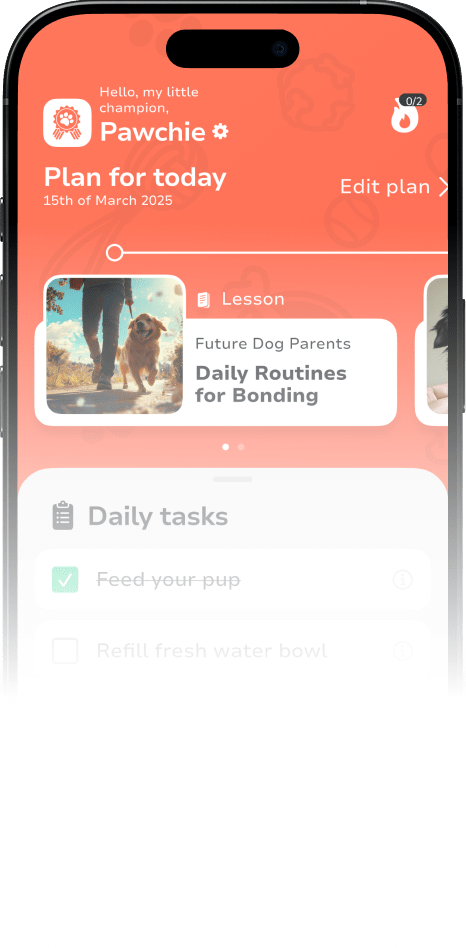
PawChamp makes it easier to build and maintain the consistent training routine that prey-drive work demands — wherever you are in your journey.
- Personalized training plan: When you join PawChamp, you get a plan tailored to your dog's breed, age, and specific challenges — including prey drive and recall — so you are never guessing which exercise to do next.
- Expert-verified lessons: Every lesson in the app is built around positive reinforcement principles and verified for accuracy, so the techniques you practice match exactly what the science supports.
- In-app expert chat: Have a question about your dog's threshold distance or whether your long-line setup is correct? You can chat directly with a Dog Training Expert or Dog Health and Care Expert inside the app for personalized guidance.
Whether you are starting from scratch or troubleshooting a recall that has stalled, PawChamp gives you the structure and expert support to keep moving forward.
Bottom Line
Stopping your dog from chasing squirrels is entirely achievable with the right approach: understand the predatory motor sequence driving the behavior, use a long line to practice safely, and build an interrupt cue strong enough to compete with prey by pairing it with extraordinary rewards and proofing it patiently through threshold-based desensitization. There are no shortcuts — the squirrel's movement is one of the most powerful natural reinforcers your dog will ever encounter — but consistent, positive reinforcement-based work genuinely shifts the behavior over weeks and months. Stay patient, keep sessions short and rewarding, and celebrate every check-in your dog offers you on the way to a reliable off-leash recall.