Your dog spots a chicken bone on the sidewalk and lunges before you even register what happened. Sound familiar? The "leave it" command is one of the most genuinely life-saving skills you can build with your dog — but only if it holds up when it counts. That means training it not just in your living room, but against the messy, unpredictable distractions of real life. Here's how to get there, step by step.
Key Takeaways
- Start "leave it" training with hand-based drills before introducing ground-level or distance distractions.
- Progress gradually — only move to harder environments once your dog succeeds reliably at the current level.
- Proofing against real-world triggers like food scraps, squirrels, and other dogs is essential for the command to stick.
- Always reward with something better than what your dog is leaving — the trade-off is the whole point.
- Consistency and short, frequent sessions beat long, irregular practice every time.
What "Leave It" Actually Means to Your Dog
Before you can teach it effectively, it helps to understand what you're really asking. "Leave it" is an impulse-control cue — you're asking your dog to voluntarily disengage from something appealing and redirect attention back to you. That's a big cognitive ask, especially for high-drive breeds like Border Collies, Labrador Retrievers, or German Shepherds.
Many owners accidentally teach "leave it" as a freeze cue — the dog stops momentarily, then dives back in the second attention drifts. What you actually want is a full redirect: dog notices the item, hears the cue, turns away, and checks in with you. That check-in is the behavior you're reinforcing, not just the pause.
It's also worth distinguishing "leave it" from teaching your dog to drop something they already have in their mouth — those are two separate skills that complement each other beautifully but shouldn't be confused during training.
What "Leave It" Actually Means to Your Dog
🧠 Think About:
Your dog isn't being stubborn when they go for something forbidden — they're following instinct. The goal of "leave it" training is to make choosing you more rewarding than following that instinct. That shift takes repetition, not scolding.
Step 1: The Closed-Hand Foundation Drill
Every solid "leave it" starts with the same humble prop: your closed fist. This drill teaches your dog the core equation — ignoring the temptation earns the reward.
- Load your fist with a low-value treat (kibble works great here).
- Present your closed fist to your dog at nose level. Let them sniff, lick, and paw at it.
- The moment they pull back — even a half-inch — click or say "yes!" and reward with a different, higher-value treat from your other hand.
- Once they're pulling back consistently, add the verbal cue "leave it" just before you present your fist.
Keep sessions to 3–5 minutes. Dogs learn faster in short bursts than in marathon sessions. Practice 2–3 times a day until your dog is backing off confidently and looking up at you after the cue. That eye contact is gold — it's the beginning of the check-in behavior you'll build on throughout every stage.
💡 Tip:
Always reward from your opposite hand — never from the fist holding the temptation treat. If you reward from the same hand, you accidentally teach your dog that nosing your hand eventually produces food, which is the opposite of what you want.
Step 2: Moving to an Open Hand and Then the Floor
Once your dog nails the closed-fist version, it's time to raise the difficulty. Open your hand flat with the treat visible. Say "leave it." If your dog dives in, close your fist again — no punishment, just a reset. When they hesitate and look at you, reward immediately.
After consistent success with the open hand, place the treat on the floor and cover it with your foot. Same process: uncover slightly as your dog backs off, then reward with something better from your hand. Never let them self-reward by getting the item on the ground — if they beat you to it, the lesson just went backward.
This stage is where many owners plateau. The key to progressing is raising only one variable at a time — either the value of the distraction OR the distance from it, never both simultaneously. This matches the same incremental logic used when you teach a dog to stay: duration, distance, and distraction are always added one at a time.
Step 3: Proofing "Leave It" in the Real World
This is where most training falls apart — not because dogs are bad learners, but because owners skip the bridge between controlled drills and chaotic real life. Proofing means deliberately exposing your dog to the actual triggers they'll face, in a controlled way, so the cue becomes reliable across contexts.
Food on the Ground
Start by deliberately dropping a piece of food during a training walk (use something low-stakes). Say "leave it" as it falls. Reward big when your dog ignores it. Gradually work up to crumbs near trash cans, food near park benches, and eventually the dreaded dropped hot dog or pizza crust. If your dog sometimes eats poop on walks — a surprisingly common issue — the same proofing protocol applies; you can read more about why dogs eat poop and how to address it alongside impulse control work.
Other Animals and Moving Triggers
Squirrels, cats, and other dogs are a completely different level of arousal than a treat on the ground. Begin at a distance where your dog notices the animal but can still think — this is called being below threshold. Say "leave it," reward the look-away, and gradually decrease distance over multiple sessions. Never rush this stage; some dogs need weeks of work at a distance before they can hold the cue at close range.
Objects, Trash, and Street Hazards
Dropped tissues, food wrappers, dead birds — dogs find them all equally fascinating. Practice "leave it" on leash with these items deliberately placed on your walking route during training sessions. The goal is a dog who hears the cue and swings their head back to you automatically, without tension on the leash.
🐾 Fun Fact:
Research in canine cognition shows that dogs who regularly practice impulse-control exercises — like "leave it" and "wait" — tend to show better overall self-regulation across a range of situations. Think of it as a mental workout: the more your dog practices choosing you over distractions, the easier that choice becomes.
Common Mistakes That Undermine "Leave It" Training
Even well-intentioned owners can accidentally slow their dog's progress. Here are the pitfalls worth watching for:
- Repeating the cue: Saying "leave it, leave it, LEAVE IT" teaches your dog that the first cue doesn't really mean anything. Say it once, then manage the situation if they don't respond, and go back a training step.
- Using "leave it" for everything: If you use the same cue for dropped food, the TV remote, the cat, and your shoes, it loses meaning. Reserve "leave it" for genuine safety and impulse-control moments.
- Rewarding too late: Timing matters enormously. If you reward two seconds after your dog looks away, they may not connect the reward to the behavior. Click or mark the exact moment of disengagement.
- Skipping proofing entirely: A "leave it" that only works at home isn't a trained behavior — it's a lucky coincidence. Proofing in real environments is non-negotiable.
- Punishing failure: If your dog fails and grabs the item, calmly reset and go back a step. Punishment creates anxiety around the training process and slows learning.
Many of these same principles apply across the essential commands every dog should know — consistent cues, clean timing, and positive reinforcement are the backbone of all reliable obedience work.
📌 Example:
If your dog grabs a treat off the floor before you can cue "leave it," don't scold them — just note that the difficulty was too high for where they are in training. Drop back to foot-covered treats for a few more sessions, then try again with less exposure next time.
How to Keep "Leave It" Sharp Long-Term
Like any trained behavior, "leave it" needs maintenance. Dogs don't generalize perfectly — a command learned in autumn in your neighborhood may need a quick refresher when you visit a new city or when seasonal distractions like geese or outdoor dining appear.
Build maintenance reps into your everyday walks: spot something interesting, cue "leave it," reward the look-away, and move on. This takes about 10 seconds and keeps the behavior crisp without formal training sessions. You can also use real-life rewards — after a successful "leave it" near a distraction, let your dog sniff freely for 30 seconds as their prize. Life rewards are powerful and free.
For dogs who are especially high-drive or who have ingrained habits around certain triggers, consider structured impulse-control games like "it's yer choice" (a popular positive-reinforcement protocol) to reinforce the underlying self-regulation muscle that makes "leave it" possible in the first place.
How Can PawChamp Help?
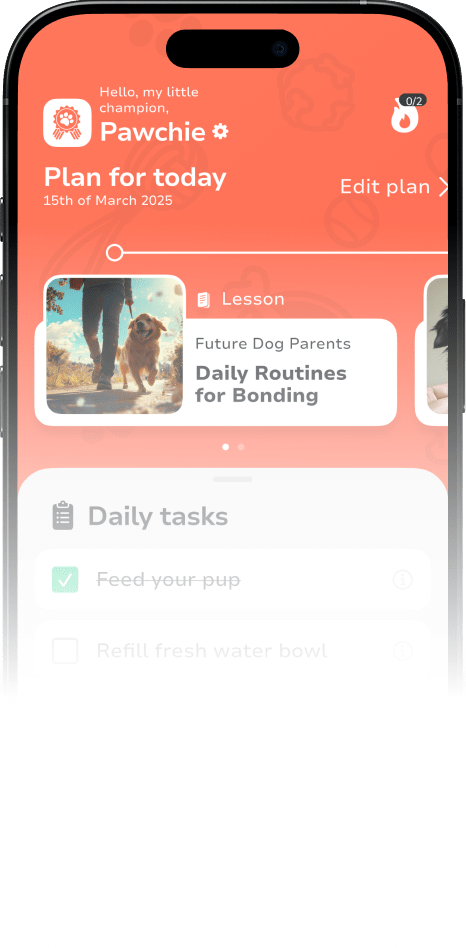
PawChamp makes it easier to build a "leave it" that actually holds up in the real world — not just in your living room.
- Personalized training plans: PawChamp tailors your dog's program to their breed, age, and specific impulse-control challenges, so you're always working at the right level.
- Expert-verified lessons: Every training step in the app is reviewed for accuracy and humane practice, so you can trust the method you're following.
- In-app expert chat: Got a specific proofing challenge — like a dog who loses it around squirrels or food on the ground? Chat directly with a Dog Training Expert or Dog Health and Care Expert for tailored guidance.
Whether you're starting from scratch or trying to proof an already-trained cue against tougher distractions, PawChamp gives you the structure and support to get there efficiently.
Bottom Line
Teaching a dog to "leave it" reliably in real-world situations is a process — it starts with hand-based foundation drills and builds, one distraction at a time, toward genuine proofing against food, animals, and street hazards. The key is progressing gradually, rewarding precisely, and never skipping the real-world practice that makes the cue stick. With consistent, positive reinforcement training, "leave it" becomes one of the most dependable and genuinely useful tools in your dog's skill set.