Your dog has just snatched your favorite sock — or worse, something genuinely dangerous — and you say "drop it." They look you dead in the eye and trot away faster. Sound familiar? Teaching a reliable drop it cue is one of the most practical skills you can give your dog, but most training guides stop at the easy version. This post goes further: we'll show you how to build a "drop it" that holds up even when your dog has something they really don't want to give up.
Key Takeaways
- Start "drop it" training with low-value items before working up to stolen socks or food.
- The trade game — swapping the item for a high-value treat — is the fastest way to build a reliable cue.
- Avoid chasing or grabbing, which accidentally rewards and reinforces keep-away behavior.
- Generalization practice (different rooms, different items) is what makes the cue truly reliable under pressure.
- Resource-guarding dogs need a careful, gradual approach — never punish growling.
Why "Drop It" Is More Than a Party Trick
A solid drop it cue is a genuine safety skill. Dogs explore the world with their mouths, which means they will, at some point, pick up something sharp, toxic, or irreplaceable. The ASPCA lists household items like grapes, xylitol gum, and small batteries among the most common canine hazards — and many of those incidents start with a dog who won't let go.
Beyond emergencies, "drop it" also protects the relationship between you and your dog. When you can calmly ask your dog to release something and they do it willingly, you avoid the tug-of-war and frustration that can quietly erode trust over time. Think of it less as a command and more as a cooperative agreement: "Give me that, and something great happens for you."
It's also worth noting that "drop it" and "leave it" are different cues. Leave it means "don't pick that up in the first place." Drop it means "release what's already in your mouth." Teaching both is ideal, but confusing the two in practice undermines both cues — so keep them separate from day one.
Why "Drop It" Is More Than a Party Trick
🧠 Think About:
Dogs don't naturally understand that giving something up is safe. Every time you chase your dog to retrieve an item, you're teaching them that holding on longer is a winning strategy. Reframing the exchange as a trade — not a theft — changes everything.
Step 1: Build the Foundation With Low-Value Items
Before you can tackle the stolen sock scenario, you need to install the behavior in a calm, low-stakes environment. Here's how to lay the groundwork.
What You'll Need
- A low-value toy your dog likes but isn't obsessed with
- High-value treats (think small pieces of cooked chicken, cheese, or commercial training treats)
- A quiet space with no distractions
The Trade Game Protocol
- Let your dog take the toy. Offer it, let them grab it, and let them hold it for a few seconds so they feel like they genuinely "have" it.
- Present a treat near their nose (don't shove it in — just let the smell do the work). Most dogs will open their mouth to investigate, and the toy will fall out.
- The instant the toy hits the ground (or leaves their mouth), say "drop it" — mark it with a calm "yes" or a click — and deliver the treat.
- Give the toy back. This is crucial. When dogs learn that dropping something doesn't mean losing it forever, they stop resource-guarding the cue itself.
Repeat 5–10 times per short session. You're not drilling — you're making the association crystal clear: mouth opens + toy drops = treat appears + toy comes back.
💡 Tip:
Keep early training sessions to 3–5 minutes. Dogs learn faster in short, positive bursts than in long, tedious drills. End every session before your dog loses interest so they're always eager to come back for more.
Step 2: Add the Verbal Cue and Fade the Lure
Once your dog is reliably dropping the toy when they smell the treat — usually within 2–4 sessions — it's time to shift the cue word to the front of the behavior and start fading the food lure.
Introducing the Verbal Cue
Say "drop it" as your dog opens their mouth (not before, not after). Timing matters here: you want the word to become a reliable predictor of the behavior, not background noise.
Fading the Lure
After a few sessions where the word and the treat appear together, try this: say "drop it" without showing the treat first. If your dog drops the item, immediately reward from your treat pouch. If they don't, no punishment — just go back to showing the lure for a few more repetitions before trying again.
The goal is a dog who drops on the word alone, with the treat appearing after the behavior — not as a bribe before it. This distinction is what separates a dog who "drops it when you have food" from one who "drops it when you ask."
Step 3: Level Up to High-Value Items and Real-World Distractions
This is where most training guides stop — and where most dogs' "drop it" starts to fall apart. Generalization means practicing the cue across different items, locations, and distraction levels until the behavior is truly reliable.
The High-Value Item Ladder
Think of items on a spectrum of how much your dog values them. Start low and climb gradually:
- A boring chew toy
- A favorite squeaky toy
- A smelly rope toy
- A sock or piece of clothing
- A raw bone or bully stick
- Stolen food off the counter
Move up the ladder only when your dog is succeeding at the current level. Raising criteria too fast is the single most common reason "drop it" breaks down under pressure.
Location, Location, Location
Practice "drop it" in the kitchen, the backyard, on walks, and in the living room. Each new environment is a new context for your dog's brain — what they've learned in the training room doesn't automatically transfer to every room in your house.
The Stolen Sock Scenario
When your dog grabs a sock and bolts, the worst thing you can do is chase them. Chase = the world's greatest unintentional game of keep-away. Instead:
- Stay calm and turn your body slightly away (reducing the "chase me!" energy).
- Crouch down or make yourself small and interesting rather than looming and reaching.
- Produce a treat (or a second toy) and calmly say "drop it."
- Reward generously the moment they release.
If this happens frequently, it's also a management issue — keep socks in a hamper with a lid until the behavior is solid.
🐾 Fun Fact:
Many dogs who seem "stubborn" about dropping items are actually just doing what evolution wired them to do — protect a resource. Breeds like Labrador Retrievers, Golden Retrievers, and Border Collies were selectively bred to carry things in their mouths, which means they may need extra practice at the "release" part of the retrieve cycle.
Handling Resource Guarding: When Drop It Gets Complicated
Some dogs don't just hold on — they freeze, stiffen, growl, or snap when approached while holding something. This is resource guarding, and it requires a more careful approach than standard drop it training.
What Not to Do
- Never punish growling. A growl is communication — suppressing it doesn't remove the underlying discomfort, it removes the warning sign. A dog who has been punished for growling is more likely to skip the warning and bite.
- Don't forcibly pry the item from your dog's mouth. This escalates tension and can trigger a defensive bite.
- Don't reach over your dog's head while they're holding something — this is a common bite trigger.
The Guarding Spectrum
Mild guarding (turning away, eating faster, a low rumble) is common and manageable with consistent training. Severe guarding — stiff body, hard stare, snapping, or biting — warrants guidance from a professional. If your dog's guarding feels serious, connecting with a Dog Training Expert before pushing further is the safest move for everyone involved.
Building Safety Around High-Value Items
For guarders, the trade game works, but you approach it differently. Drop treats near the item — not directly at your dog's mouth — so they learn that your approach predicts good things, not resource loss. Over many repetitions, the dog's emotional response to you approaching their item shifts from anxiety to anticipation. This is the foundation of real, lasting change.
Dogs who have shown guarding behavior can also benefit from a structured bonding and confidence-building routine. If you've ever wondered how emotional security connects to behavior, our piece on what emotional support dogs are and how the bond works offers some useful perspective on the dog-human connection.
✋ Remember:
Resource guarding exists on a spectrum, and mild cases often improve significantly with consistent positive reinforcement training. But if your dog's reaction to you approaching their food or toys feels intense or unpredictable, please seek professional support before continuing. Your safety and your dog's wellbeing both matter.
Common Mistakes That Slow Down "Drop It" Training
Even experienced dog owners hit predictable snags with this cue. Here's what tends to go wrong — and how to course-correct.
Repeating the Cue Multiple Times
Saying "drop it, drop it, DROP IT" teaches your dog that the first request is optional. Say it once, wait, and if there's no response, go back a step in your training rather than nagging.
Only Asking for Drop It When You Need to Take Something Away
If your dog learns that "drop it" always results in losing the item permanently, they'll start avoiding the cue. Practice "drop it" during play, give the item back nine times out of ten, and your dog will learn it's a safe, profitable behavior.
Using Punishment When It Doesn't Work
Grabbing, scolding, or physically forcing your dog to drop something damages trust and makes future training harder. If the cue isn't working, the answer is more training at an easier level — not more pressure.
Skipping Generalization
Training "drop it" only with a tennis ball in the living room creates a dog who drops a tennis ball in the living room. Vary the items, vary the locations, and vary the distractions to build a truly bulletproof cue.
How Can PawChamp Help?
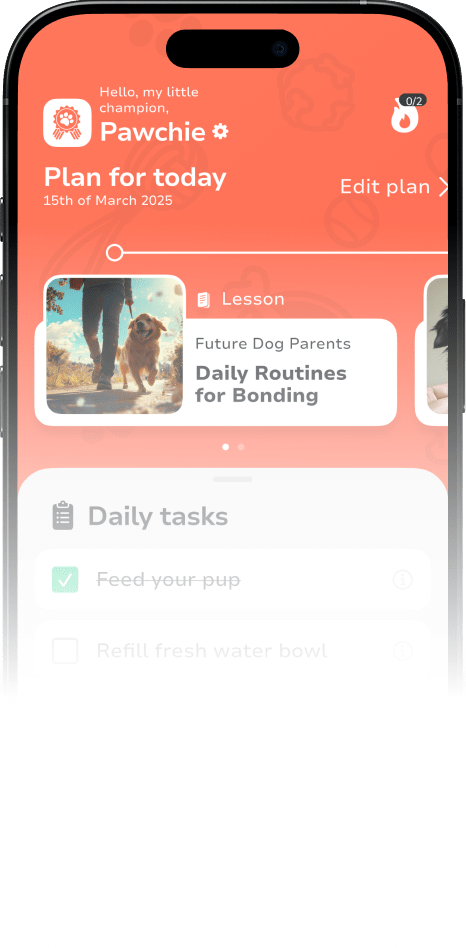
PawChamp makes building reliable cues like "drop it" simpler and more effective with tools designed specifically for real-life dog training challenges.
- Personalized training plans: PawChamp builds a customized plan based on your dog's breed, age, temperament, and specific behavior challenges — so you're not guessing at which step comes next.
- Expert-verified lessons: Every technique in the app has been reviewed for accuracy and humane practice, so you can trust that what you're teaching is both effective and kind.
- In-app expert chat: When "drop it" training gets tricky — especially around resource guarding — you can connect directly with a Dog Training Expert or Dog Health and Care Expert inside the app to get guidance tailored to your dog's situation.
Whether you're starting from scratch or trying to fix a "drop it" that falls apart the moment your dog finds something truly exciting, PawChamp gives you the structure and support to get there.
Bottom Line
Teaching a reliable "drop it" cue is one of the best investments you can make in your dog's safety and your own peace of mind. The key is building the behavior gradually — starting with easy items, fading the lure, and steadily working up to the stolen socks and counter-grabbed chicken wings of real life. With patience, consistency, and the right approach to any resource guarding that comes up, most dogs can learn a drop it that holds up even when they really, really don't want to let go.