You ask your dog to sit. He looks at you, looks away, and wanders off to sniff a blade of grass. You've seen it a hundred times, and by now you've probably labeled him "stubborn." But here's the thing — your dog almost certainly isn't being defiant. He's telling you something you haven't quite decoded yet. And once you crack that code, training gets a whole lot easier.
Key Takeaways
- What looks like stubbornness is almost always a gap in motivation, communication, or foundational skills — not defiance.
- Dogs disengage when training feels irrelevant, confusing, or unrewarding relative to the environment.
- Shrinking criteria, raising reward value, and shortening sessions can turn a "switched-off" dog back on quickly.
- Consistency between all household members matters as much as the technique you choose.
- A personalized training plan — rather than a one-size-fits-all approach — closes the gap far faster.
'Stubbornness' Is Not a Personality Flaw
The word "stubborn" puts the problem inside the dog. It implies the dog understands what you want and has simply decided not to comply. In practice, that's rarely what's happening. Dogs don't hold grudges, stage silent protests, or decide to be difficult for sport.
What they do is make constant cost-benefit calculations, most of them unconscious. If the reward for listening to you is smaller than the reward for following that scent trail, your dog isn't being stubborn — he's being rational. The environment is simply outbidding you.
Breeds that are commonly labelled stubborn — Basset Hounds, Afghan Hounds, Siberian Huskies, Chow Chows, and Dachshunds — were selectively bred to work independently of human direction. That self-reliance isn't a character defect; it's the entire point of the breed. Understanding that shifts your job from "winning a battle of wills" to "making cooperation more compelling than independence."
'Stubbornness' Is Not a Personality Flaw
🧠 Think About:
Your dog's breed history is a clue, not an excuse. A Siberian Husky was bred to make decisions miles ahead of the sled — that same independent thinking shows up at the park when you call him back. Work with the instinct by making yourself the most interesting thing around, rather than fighting the instinct head-on.
The Four Most Common Training Gaps Behind 'Stubborn' Behavior
Before you change your technique, diagnose the real gap. Most cases fall into one of four categories:
1. The Reward Isn't Worth the Effort
Dogs who perform perfectly at home but fall apart outdoors haven't suddenly become stubborn — they've encountered a richer environment. The fix is to raise the reward value to match the distraction level. Kibble that works in the kitchen may need to be swapped for real chicken breast, cheese, or a quick tug game outside. Match the currency to the competition.
2. The Cue Has Lost Its Meaning
Repeating "sit, sit, sit, SIT" teaches your dog that the first word was optional. This is called cue poisoning. Dogs trained this way learn to wait for the "serious" signal — the louder voice, the leaning forward — rather than the word itself. Say a cue once, wait a beat, and if there's no response, help your dog into position rather than repeating yourself.
3. Criteria Were Set Too High, Too Fast
If you asked for a 30-second stay on day two, or a reliable recall in a busy dog park before it was solid in the garden, you may have created a dog who has simply learned that this particular exercise is too hard. Shorten the task, get several quick wins, and rebuild duration, distance, or distraction one variable at a time — never all three at once.
4. Mixed Signals from the Household
One person allows counter-surfing; another corrects it. One person uses "down" to mean lie flat; another uses it to mean get off the sofa. Dogs don't generalize human language the way we expect — inconsistency doesn't confuse them, it simply teaches them that the rules are optional. A single, shared vocabulary across every person in the house is non-negotiable for reliable behavior.
📌 Example:
A Border Collie owner reported her dog "refused" to come when called at the beach. When she switched from dry kibble to a small ball toss as the reward, recall became instant — the dog wasn't stubborn, the reward just wasn't interesting enough to compete with the waves. The fix took one session.
How to Rebuild Engagement with a Switched-Off Dog
Once you've identified the gap, the rebuild follows a straightforward sequence. The goal is to make your dog want to check in with you — not to force compliance.
Start with a Blank Slate: Reset Sessions
Take your dog somewhere boring — an empty car park, a quiet hallway — with no distractions and no prior frustration. Keep the session to three to five minutes maximum. Ask only for behaviors your dog already knows cold. Reward generously. End before he's tired. Short, successful sessions rebuild a dog's confidence that training is worth engaging with.
Use Premack: Let the Environment Work for You
The Premack Principle states that access to a high-value activity can reinforce a lower-value one. In plain language: let sniffing that bush be the reward for a good sit. Let the off-leash run be the reward for a solid recall. You stop fighting the environment and start using it as your best training tool.
Mark the Moment — Precisely
A clicker or a crisp verbal marker like "yes!" tells your dog the exact moment he did the right thing. Fuzzy timing — handing over a treat two seconds after the behavior — teaches fuzzy behavior. Learning how marker training works in a structured app environment can help you see just how much your timing affects results, even with an adult dog.
Train Toward the Dog, Not Away from the Problem
Rather than drilling the exercise your dog is failing, ask yourself: what does my dog love doing? Build a training game around that. If your Labrador is obsessed with fetch, ask for a sit before every throw. If your Beagle loves sniffing, hide a treat in a scatter and ask for eye contact first. Engagement follows joy — not pressure.
The Role of Clarity, Consistency, and Timing
Even the best rewards fail if the communication around them is muddled. Here's what clarity actually looks like in practice:
- One cue, one behavior. Pick a single word for each behavior and write it on a sticky note on the fridge if you have to. Everyone in the house uses that word and no other.
- Reward the attempt, not just the perfect rep. When rebuilding a behavior, click for any movement toward the right answer. A dog who tries and gets paid will try harder next time.
- End on a win. Never close a session on a failure. If your dog is struggling, go back one step to something easy, get a confident response, reward it, and stop there.
- Train the dog in front of you. The dog who "should" know this by now isn't the dog you're training. If he's not getting it, the criteria need to come down — full stop.
Consistency isn't about being strict — it's about being predictable. Dogs thrive on predictability because it makes the world feel safe and navigable. A dog who knows exactly what earns a reward is a dog who will work for it. If you're wondering whether professional guidance could help you stay consistent, it's worth understanding what different training formats cost and deliver before committing to one approach.
💡 Tip:
Set a phone timer for three minutes at the start of every training session. When it rings, do one final easy cue, reward it warmly, and stop. Three focused minutes beats twenty unfocused ones every single time — for the dog and for you.
Health and Nutrition: The Often-Missed Variable
A dog who has suddenly become less responsive to training — especially one who was previously reliable — deserves a health check before a training overhaul. Pain, thyroid imbalance, ear infections, vision changes, and joint discomfort can all make a dog appear "checked out" or reluctant to move into position. Rule out physical causes first.
Nutrition matters too. A dog running on a low-quality diet may have less energy and drive for training than one eating food that genuinely supports his brain and body. While this post isn't a nutrition guide, understanding what a genuinely balanced diet looks like is worth your time if your dog's engagement has dropped alongside other changes in energy or coat quality.
If you're unsure whether something physical could be affecting your dog's responsiveness, the Dog Health and Care Expert available through PawChamp's in-app chat can help you figure out whether a vet visit should come before your next training session.
🐾 Remember:
A sudden change in a previously cooperative dog is almost always worth a vet check. Stubbornness that appears out of nowhere — especially in an older dog — can signal pain or a medical issue that training alone will never fix.
How Can PawChamp Help?
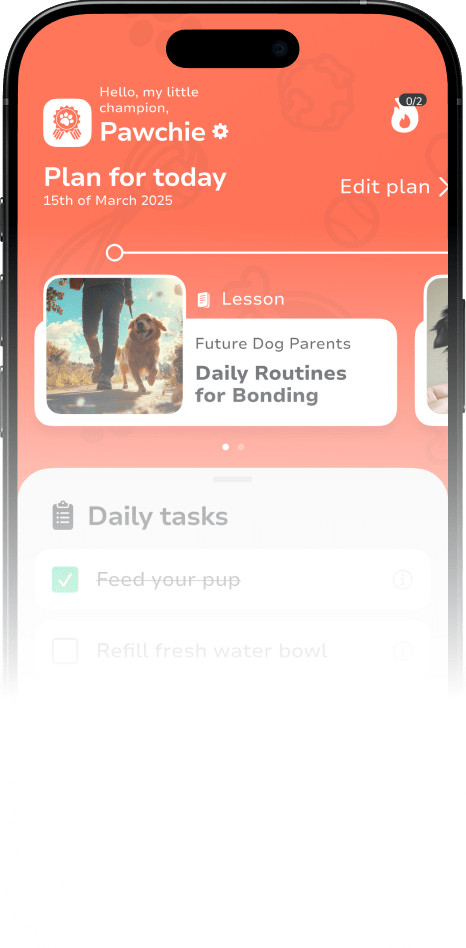
PawChamp was built specifically for the reality that every dog — and every training gap — is different. Here's how the app addresses the exact problems this post describes:
- Personalized training plans: Your dog's plan is built around his breed, age, current skill level, and the specific behaviors you're working on — not a generic curriculum designed for the average dog.
- Expert-verified lessons: Every exercise in the app is reviewed for accuracy and humane methodology, so you're never accidentally reinforcing the wrong thing or asking for criteria your dog isn't ready for.
- In-app expert chat: Connect directly with a Dog Training Expert or a Dog Health and Care Expert when you hit a wall — whether the question is about timing, reward choice, or whether a behavior warrants a vet visit.
Whether your dog has switched off after months of confusing signals or has always been the independent type, PawChamp gives you a structured, expert-backed path to rebuild that connection.
Bottom Line
What looks like stubbornness in dogs is almost always a gap in motivation, communication, or training criteria — and every one of those gaps is fixable. By raising reward value, sharpening your timing, simplifying your cues, and keeping sessions short and successful, you can turn a disengaged dog into an enthusiastic training partner. The key is to stop trying to overpower the problem and start diagnosing what your dog is actually telling you.