Your dog bolts toward another dog, a squirrel, or simply the smell of something irresistible — and your heart sinks because you know your recall isn't strong enough yet to trust them off-leash. Sound familiar? A long line is the bridge between a tight leash and true off-leash freedom, and most dog owners have never even picked one up. If you want to build a bombproof recall without the anxiety of watching your dog disappear into the distance, this guide is exactly what you need.
Key Takeaways
- A long line is a 15–50 ft leash that gives your dog freedom to move while keeping you in control — a must-have for recall training.
- Proper mechanics (no tangling, right attachment point, correct surface) make long-line work safe for both dog and handler.
- A structured progression — from short distances to full-line length — builds a reliable recall before you ever drop the leash.
- Long lines work for dogs of all ages and are especially valuable for high-drive breeds, rescue dogs, and puppies.
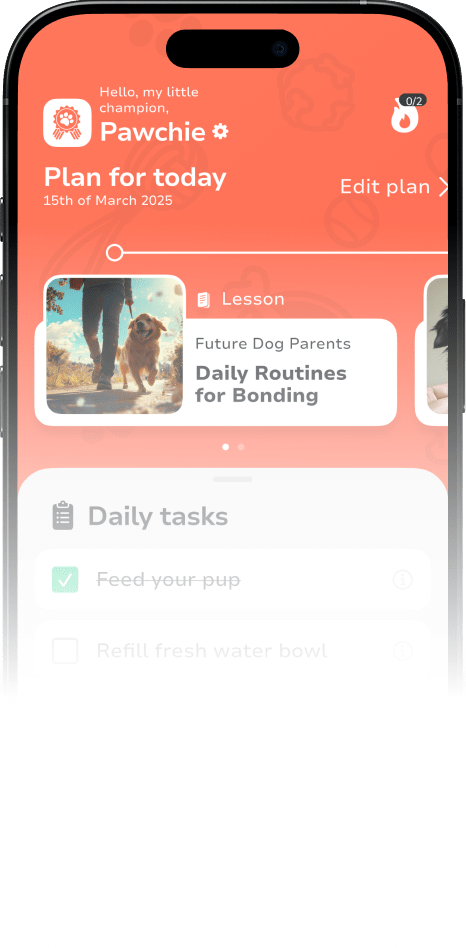
- The PawChamp app can guide you through every step with personalized training plans and in-app expert support.
What Is a Long Line and Why Does It Matter?
A long line (also called a drag line or check cord) is simply a lightweight leash that comes in lengths between 15 and 50 feet. Unlike a standard 6-foot leash, it gives your dog room to sniff, explore, and move naturally — while you maintain a safety net you can step on or reel in at any moment.
Think of it as a training tool, not a permanent management solution. The long line exists to let you practice real-world recall scenarios in real-world environments without gambling with your dog's safety. Parks, open fields, hiking trails — every place where your dog needs to eventually listen off-leash becomes a classroom with a long line attached.
The mistake most owners make is jumping straight from a 6-foot leash to off-leash freedom the moment their dog seems "pretty good" in the backyard. That gap is enormous, and it's exactly where recall fails. Understanding how long it really takes to train a dog puts this in perspective — reliable recall in distracting environments can take months of deliberate practice, and the long line makes that practice possible.
What Is a Long Line and Why Does It Matter?
🐾 Fun Fact:
Long lines have been used by professional gun dog trainers for over a century. They're a staple in field sports training for breeds like Labrador Retrievers, German Shorthaired Pointers, and Vizslas — but they work just as well for your neighborhood mixed-breed or family Goldendoodle.
Choosing the Right Long Line
Not all long lines are created equal, and choosing the wrong one can make training frustrating or even unsafe. Here's what to look for:
Length
15–20 feet is ideal for beginners and dogs in progress with distractions. 30 feet is the sweet spot for most recall work in open spaces. 50 feet suits confident handlers and wide-open environments where you want to simulate true off-leash distance.
Material
- Biothane — waterproof, doesn't tangle as badly, easy to wipe clean. The top choice for most trainers.
- Nylon — affordable and widely available, but can cause rope burn and tangles more easily.
- Cotton — gentler on hands, but absorbs water and mud and dries slowly.
Attachment Point
Always clip the long line to a well-fitted flat collar or back-clip harness — never to a front-clip harness, slip lead, or prong collar. A front clip can twist your dog awkwardly when the line goes taut; a slip lead can tighten dangerously if your dog hits the end of the line at speed.
Weight
Choose the lightest line that still gives you control. A heavy line drags on a small dog and discourages natural movement. For dogs under 20 lbs, look for a 1/4-inch width; for larger dogs, 1/2-inch biothane handles well without being cumbersome.
⚠️ Tip:
Never let a long line run freely through your hands at speed — the friction can cause serious rope burns in a split second. If your dog bolts, drop the line and step on it rather than trying to grab and hold it. Always wear closed-toe shoes during long-line sessions for exactly this reason.
Long Line Safety: The Rules That Protect Both of You
The long line is safe when used correctly — and genuinely hazardous when it isn't. Before your first session, internalize these non-negotiables:
- Keep the line off the ground in crowded areas. In parks with other people, a trailing 30-foot line is a trip hazard. Either coil the slack in your hand or choose quieter locations.
- Avoid forested or bushy terrain until you're confident. Lines snag on roots, branches, and undergrowth fast — your dog can get tangled or you can lose control suddenly.
- Never tie the long line to yourself. A large dog at full speed can knock you off your feet or drag you. Step on the line; don't anchor it to your body.
- Check hardware before every session. Snap hooks wear out. Inspect the clip and the stitching at both ends before you head out.
- Match the line length to the environment. Start shorter in new or higher-distraction environments and build up as your dog's focus improves.
One often-overlooked factor: surface matters. Grass is forgiving — the line slides over it cleanly. Gravel and pavement are harder on the line's integrity and on your dog's paws if they slip. Choose soft, open ground especially in the early weeks of training.
Building Recall With a Long Line: A Step-by-Step Progression
This is the heart of long-line work. Before you start, your dog should already understand the basics of coming when called in low-distraction settings — your living room, your backyard, a quiet hallway. The long line takes that embryonic skill and stress-tests it in the real world.
Step 1: Line Awareness (Days 1–3)
Let your dog drag the long line around a familiar, low-distraction environment — your yard or a quiet park corner. Do nothing yet. The goal is for your dog to become comfortable with the weight and feel of a trailing line without associating it with pressure. Most dogs ignore it within 10 minutes.
Step 2: Short-Distance Recall With a Happy Cue (Days 3–7)
With 15 feet of line out, call your dog with your recall cue (usually "Come!" or "Here!") in a cheerful, high-pitched voice. The moment they turn toward you, back away quickly — movement triggers chase instinct and makes coming to you feel like a game. Reward with your highest-value treat and big, genuine praise the second they reach you. Do 5–8 repetitions per session, always ending on success.
Step 3: Add Light Pressure — Gently (Days 7–14)
If your dog ignores your recall cue, apply a light, steady reel-in on the line — think fishing, not yanking. The moment they start moving toward you voluntarily, release all tension and let their momentum carry them in. You are using the line as a prompt, not a punishment. Reward arrival lavishly every single time.
Step 4: Increase Distance and Distractions (Weeks 2–4)
Extend to your full line length. Begin practicing near (not in the middle of) distractions: other dogs visible in the distance, joggers, squirrels. Call before your dog is fully fixated — set them up to succeed, not to fail. Gradually close the gap between your dog and distractions as their response rate improves.
Step 5: Drop the Line — Then Pick It Back Up
Before going truly off-leash, practice with the line trailing freely on the ground. Your dog doesn't know you're not holding it. Call them, see if they respond. If they don't — pick it up calmly and reel them in without drama. This stage reveals exactly how strong the recall really is before you remove the safety net permanently.
💡 Tip:
Your recall cue should never be poisoned by using it for something your dog dislikes — bath time, nail trims, or the end of a fun play session. Keep "Come!" exclusively positive. Use a neutral cue like "Let's go" for things your dog is less enthusiastic about so your recall word stays golden.
Common Long Line Mistakes (And How to Avoid Them)
Even well-intentioned owners make these errors. Recognizing them early saves weeks of frustration:
- Repeating the cue multiple times. Say "Come!" once, clearly. Repeating it teaches your dog that the first call is optional. If they don't respond, use the line — then call once as they move toward you to reinforce the word.
- Reeling in too hard. A sharp jerk is startling and can create negative associations with coming to you. Steady, gentle pressure always.
- Letting the line go slack and tangled. Manage your slack actively. Coil excess line loosely in your non-dominant hand so you can let it out smoothly and gather it without chaos.
- Ending sessions when your dog stops complying. Always end on a success, even if you have to make the last rep really easy — a recall from 5 feet away with zero distraction so your dog gets that final reward and positive association.
- Skipping low-distraction practice. It's tempting to go straight to the busy dog park to "proof" the recall. Increase difficulty gradually. Distraction is a variable — turn it up slowly like a dial, not a light switch.
Recall training is a long game, but the payoff — a dog you can trust in the world — is completely worth it. Keep sessions short (10–15 minutes), frequent (daily if possible), and always fun.
🧠 Think About:
Rate your training environment on a distraction scale of 1–10 before each session. Your backyard with no one around is a 1. A busy public park on a weekend is an 8 or 9. Your dog's current recall should be near-perfect at level 5 before you practice at level 6. Jumping three levels at once is where recall breaks down — and where owners lose confidence in the tool.
How Can PawChamp Help?
PawChamp takes the guesswork out of recall training by giving you a structured, science-backed plan tailored specifically to your dog's age, breed, and current skill level.
- Personalized training plans that progress you and your dog through exactly the kind of step-by-step recall progression described in this article — at your pace, not a generic one-size-fits-all schedule.
- Expert-verified lessons on long-line mechanics, recall cue building, and distraction proofing — all reviewed for accuracy and humane, positive reinforcement methods.
- In-app chats with a Dog Training Expert so you can ask specific questions about your dog's behavior, get feedback on your technique, and troubleshoot the moments when your recall falls apart.
Whether you have a rocket-speed Border Collie or a stubborn Beagle with a nose that rules the universe, PawChamp helps you build the recall your dog is capable of.
Bottom Line
A long line is one of the most underrated tools in dog training — a safe, humane bridge that gives your dog genuine freedom to explore while you build the recall skills needed to eventually trust them off-leash. Use it consistently, follow a structured progression from short distances to full-line length, and resist the urge to rush. The dog who runs joyfully back to you every single time, in every environment, is built through patient repetition — and the long line is the tool that gets you there.