If you're planning to get your first dog, congratulations! You are on the right path and I am so glad that you are here. I always highly recommend that future dog parents conduct careful research before committing to years of unconditional love and muddy paw prints.
Yes, because picking a dog should never be a lighthearted decision. And the main focus should be temperament, trainability, and lifestyle match rather than picking the cutest puppy or the trendiest dog breed on Instagram.
Most importantly? The research process should be joyful rather than boring.
With nearly 300 recognized dog breeds, it’s easy to feel overwhelmed and fall into a state of helplessness, but the good news is that it doesn’t have to be this way. After all, you’re not choosing a life raft, a parachute or a spouse (although dogs in my opinion do qualify as family :)
So stop staring blankly at breed charts while questioning every life choice, and let me help you sort through the many breeds (with a pinch of well-placed humor).
Key takeaways
“Beginner-friendly” means emotionally resilient, people-focused, and easier to train, not “effortless”
Labs, Goldens, Poodles, Cavaliers, and Bichons are often good first-dog choices because they’re cooperative and forgiving
Mixed-breed adult dogs can be excellent for first-time owners because their temperament and size are already visible
Size affects logistics more than behavior, so focus on energy level and trainability
Some breeds are doable but demand advanced skills, structure, and a lifestyle built around training
What Makes a Dog “Beginner-Friendly”?
Name the word “beginner-friendly dog breeds,” and images of dogs that magically housetrain themselves and walk politely on a loose leash come to mind.
As tempting as this vision may be, it’s important to consider that no dog comes prepackaged with fully factory-installed impulse control and a firm understanding of human expectations. In reality, the term “beginner-friendly” shouldn’t translate into effortless. Of course, no dog enters your home with pre-programmed manners, emotional regulation, and an understanding of human furniture rules.
What we’re actually after when talking about the best dog breeds for first time owners is a dog who is more likely to:
recover quickly from new experiences
tolerate normal human mistakes
stay motivated to work with people
learn routines without spiraling into stress
So the most important traits are stable temperaments, trainability, moderate energy levels, low reactivity, and, last but not least, forgiveness for human error.
A List of Best Dog Breeds for First Time Owners (and Why)
These dog breeds are suitable for first-time dog parents because they tend to succeed despite first-time ownership mistakes.
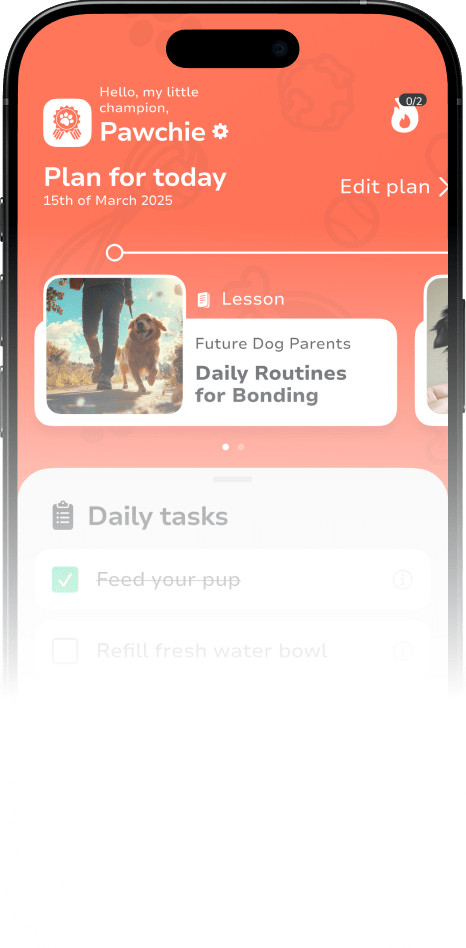
Even the most beginner-friendly breeds still need training and a routine that makes sense in real life. PawChamp helps you build essentials like calm leash walking, focus, and household manners in small steps, so training doesn’t take over your whole day.
Labrador Retriever
Labradors are popular dogs with a reputation for being easy to train and an excellent dog breed for first-time dog parents, but what makes these dogs specifically suited for beginners?
For starters, Labs were selectively bred for tasks that required teamwork. These tasks required close human cooperation and reliability under distractions. Their biddability (ability to enjoy learning for its own sake) also makes them great candidates as guide dogs for the blind and mobility assistance dogs.
💡 Did you know?
Originating in Newfoundland, Labs were literally bred to listen, as their jobs ranged from working alongside fishermen to retrieve nets (and escape fish) from icy waters to retrieving downed ducks.
Labs are also known for being high-energy and having a great appetite. Interestingly, research published on Cell Metabolism found that about 1 in 4 Labs have a gene alteration that may be the cause of their insatiable appetite. This makes them enthusiastic learners when treats are used to positively reinforce desired behaviors (but they will also eat your sandwich if unattended).
Golden Retriever
If Labradors are the dependable overachievers who will bring you your keys, Golden Retrievers share the same philosophies, but they also check on your feelings while doing it.
Like Labs, Goldens were selectively bred for cooperation. These lovely dogs were developed to retrieve downed birds from both land and water.
Like Labradors, they were bred for teamwork with humans. Their line of work required responsiveness to subtle human cues, calmness around gunfire, and a soft mouth for retrieving birds intact without bite marks (making them perfect for the dinner table).
Golden Retrievers are also famously biddable, deeply attuned to human emotions, and often tolerant of handling. These people-pleaser traits make them optimal for assistance roles such as service work and therapy programs, and excellent emotional buffers for inexperienced dog parents.
Poodle
Poodles come in three main sizes: toy, miniature, and standard. Regardless of size, Poodles have a strong reputation for being highly intelligent dogs that make excellent companions for beginners.
Despite their fancy hairdos, Poodles originated as hard-working dogs. This breed’s name, after all, is coined after the German word “Pudel,” which means “to splash.” Their main tasks?
Poodles were used for retrieving downed waterfowl, detecting truffles, and they even made wonderful star performers for European traveling circuses, but not because they were “prissy” but simply because they were ridiculously trainable, eager to receive attention, and capable of chaining long sequences of behaviors.
💡 Just remember:
If you don’t give a Poodle a job, they will likely invent one (and it may not always be one you like).
These task-oriented, bold learners therefore make great dogs for beginners because of their strong human focus, high attention to cues, and cognitive flexibility.
Cavalier King Charles Spaniel
If a group of dogs were invited to a dinner party, the Cavalier King Charles Spaniel would be the one sitting politely next to you, making lovely eye contact and contemplating the fact that you have now become their entire emotional ecosystem.
These adoringly cute dogs were developed as companion dogs rather than workers. They were lap warmers for the royalty, comfort companions, and therapy dogs before therapy dogs were even a “thing”.
In a nutshell, Cavalier King Charles Spaniels are known for their remarkable attachment to humans, gentle temperaments, and tolerance of handling. When trained, these sensitive dogs respond well to gentle praise and reinforcement. They thrive on social contact and may become distressed if left alone for too long.
These sweet dogs are great matches for seniors, families with gentle children, and folks who want a dog but without a major lifestyle overhaul.
Bichon Frisé
These fluffy, white, marshmallow-like dogs are also blessed with a history as human-centered companion dogs. While they are believed to descend from the Barbet, a French water dog, these small dogs have perfected international travel long before humans invented passports.
💡 Did you know?
They make good potential hypoallergenic dogs for beginners (although no dog can be guaranteed to be hypoallergenic).
While the early versions of the breed were found in Spain, Spanish seamen transported them to Tenerife in the Canary Islands, where they did what they do best: charming everyone.
Soon, they had infiltrated the royal courts of Spain, Italy, and France, securing the position of lap warmer to European nobility. Italian sailors further expanded this breed’s popularity by taking them along on their voyages to continental Europe, where they were recognized for their morale-boosting qualities.
Now, it’s worth pointing out that a dog breed that successfully navigated ships, ports, and royal courts couldn’t do so by being difficult. Their history explains why modern Bichons are socially flexible, human-focused, and emotionally resilient dogs who make excellent beginner dogs.
Mixed-Breed Dogs (Yes, Really)
Often overlooked, mixed-breed dogs (the average mutt) can make excellent beginner-friendly dogs for a simple reason: these dogs are often already trained and have been behaviorally assessed. This is a big advantage without paying the purebred price tag.
In particular, you want to look for adult mixed-breed dogs, which means that their temperament, size, and energy levels are already apparent. This means that what you see is what you get. You’re basically adopting the dog they actually are, not the dog they might become.
The advantages of adopting a mixed-breed dog from a shelter are several:
1. For starters, you get to meet the actual dog and can observe his/her sociability and energy levels.
2. Furthermore, shelter staff and foster insights can provide you with crucial information such as how the dog behaves in a home, whether they’re good with children, dogs, or cats, and what may stress them out. This real-world data is behavioral gold.
Of course, there are no guarantees, though. Some dogs at the shelter may appear shut down, overly calm, or overstimulated. A dog who seems “easy” in a kennel may become more energetic at home once the “honeymoon period” is over.
Of course, these issues can be navigated with professional help, but if you are concerned, you can always consider fostering. Fostering before adopting can help you observe the dog in a home environment and ultimately help you make an informed decision.
Small or Large Dog Breeds?
This is a question I am often asked, and my common answer to this is: it depends. Let me first clear up one common myth: the idea that small dogs are easier for beginners.
Here’s the scoop: size predicts logistics (such as how much space they take on the couch) more than temperament. Some small dog breeds may not be suitable for first-time pet parents. Some small dogs are simply big dogs trapped in petite bodies.
If kids are part of your household now (or soon), breed research needs one extra filter: patience, recovery speed, and comfort around unpredictable noise and movement. Here’s our guide to the best dog breeds for families with kids.
Take the Jack Russell Terrier, for instance. These small dogs have the cutest faces, but they’re basically a caffeine shot covered with fur. This means these cute dynamo dogs need constant mental and physical stimulation, which makes them surprisingly challenging to own.
Even the Jack Russell Terrier Club of America mentions how even some experienced dog parents become overwhelmed by the special needs of this breed, sadly leading to many of them being surrendered to shelters even before they reach adulthood.
For beginners, neither small nor large is “better.” This is because what ultimately matters is temperament, energy level, and trainability more than size. Sure, a large unruly dog is more difficult to manage, but a small unruly dog is just easier to excuse, overlook, or physically contain.
This free pass for behaviors that would be unacceptable in a larger dog often delays the training and behavior support the small dog actually needs. This explains why there are so many small dogs with behavioral problems.
Breeds First Time Owners Should Think Twice About
And of course, the list of easiest dog breeds to own wouldn’t be complete without mentioning some dog breeds that should be avoided at all costs, but let me reframe this.
It’s just that certain dog breeds simply demand more skill, consistency, and lifestyle alignment. I like to compare these dog breeds with high-performance sports cars. Sure, they are gorgeous, exhilarating, but they are not exactly beginner-friendly.
What makes them more challenging to own? The fact that they require constant attention, early structured training, a skilled pet parent, and a lot of maintenance. There are many more laid-back dog breeds that are more like reliable sedans: adaptable, forgiving, and a little easier to live with when you’re learning the ropes.
What dog breeds would I consider more for the advanced-level household? I am talking about dog breeds like the Belgian Malinois, Border Collie, Akita, Cane Corso and Chow Chow. I see these dogs as a far cry away from the average starter dogs, and more like capstone projects.
Puppy or Adult Dog?
This question is similar to asking, “Do you want to raise a toddler, or adopt a reasonably functional roommate?”
Sure, puppies are adorable, but they can be bitey, exhausting, and not good for folks who struggle with being sleep-deprived. Puppies also require near-constant supervision, thoughtful socialization during a narrow developmental windo,w and the patience of a saint.
Compared to adult dogs, puppies are like clay; they are in the process of being molded, and as a beginner you would need to learn how to “sculpt.”
Adult dogs are more predictable. They arrive with established temperaments, known energy levels, and fully developed coping skills. However, some adult dogs come with some emotional baggage that requires some effort to overcome.
First Dog Checklist
Here are some general guidelines to help you start your journey with your new dog from the right paw. For example, within the first 7 days, you want to:
Schedule a vet appointment
Provide your dog with an ID tag and microchip
Use training treats to reinforce desired behaviors
Purchase enrichment toys (food puzzles, Licki-mats)
Create a safe space (crate, exercise pen)
Help your dog habituate to wearing a leash and harness
Establish a daily routine (sleep, going potty, play times, walkies)
If you’re second-guessing yourself, that’s normal. PawChamp lets you ask a dog expert for personalized advice, so you’re not trying to solve everything through random internet opinions.
Example of a Routine
Dogs thrive when they are provided with a daily routine. Predictability equals emotional safety to dogs. Of course, this is only an example, routines will need to be adjusted based on several factors. For example, a puppy will need more potty breaks, while an energetic dog breed may need more exercise and mental stimulation.
Morning
Potty Break
Walk or light exercise
Breakfast
Midday
Potty break
Enrichment activity
5 to 10 min training session (depending on dog’s age/history of training)
Evening
Walk or play
Dinner
Calm downtime
Final potty break
Consistent bedtime
Example of a Routine
Dogs thrive when they are provided with a daily routine. Predictability equals emotional safety to dogs. Of course, this is only an example, routines will need to be adjusted based on several factors. For example, a puppy will need more potty breaks, while an energetic dog breed may need more exercise and mental stimulation.
Morning
Potty Break
Walk or light exercise
Breakfast
Midday
Potty break
Enrichment activity
5 to 10 min training session (depending on dog’s age/history of training)
Evening
Walk or play
Dinner
Calm downtime
Final potty break
Consistent bedtime
How PawChamp helps first-time dog parents
First-time dog parents rarely struggle because they lack love. They struggle because consistency is hard when life is busy, sleep is short, and online advice is all over the place.
PawChamp is an online training platform for dog parents looking for a modern and personalized approach to raising well-behaved, happy dogs. It helps you turn good intentions into a routine you can repeat.
Here’s what you get:
Step-by-step training guidance you can follow at home or on walks
Daily structure that helps you stay consistent without overthinking “what to train next”
Expert support for setbacks like pulling, jumping, barking, or alone-time struggles
The result is simple: fewer accidental bad habits, more calm progress, and a plan that still works on busy days.
Final PawChamp Dog Expert Reality Check
As a certified professional dog trainer and behavior consultant I can fully understand how challenging it may feel to choose between over 300 dog breeds, but here’s one very important consideration, there ultimately isn’t one truly perfect dog breed for beginners. It all boils down to finding the dog what best matches your lifestyle, fits your energy level and has a stable temperament. The best dogs for first time owners are emotionally resilient, socially flexible, and less likely to spiral when you Google “how to train a dog” at 2 a.m.