Some large dog breeds will ignore every treat you offer. Others lock eyes with you like you're the most important person in the world — and mean it. That difference isn't training. It's weird. The easy to train large dog breeds don't just work for food — they're built to cooperate with you. Here's which breeds make that list, and how to get the best out of them.
Key takeaways
The dogs that are easy to train are not just motivated by treats, but they also have an inherent desire to cooperate with you. There are 6 characteristics you need in a dog if you want one that is “easy to train”.
To give you a better understanding of the “easy to train” breeds, I’ve given each breed a classroom personality so you know exactly what kind of learner you’re bringing home.
Letting undesirable behaviors slide in puppyhood, inconsistency and training without structure are some of the many things you must avoid when training a large dog.
6 Traits That Make Large Dogs Easy to Train
Trainability is essentially a match between the dog's temperament and your ability to be patient, consistent, and actually show up to do the work.
In my 10+ years of experience training dogs and humans, I've noted that these are 6 characteristics that make a dog easy to train:
Willingness to please people (most important and a non-negotiable to be categorized into "easy to train").
Ability to hold attention and focus (A Lab is way more capable of holding a Stay at the sight of a rat than a Jack Russell Terrier).
Food and toy motivation (first-time owners would typically use treats and toys as a reward for training. A dog that responds to these repeatedly is usually easy to train).
Medium to high tolerance (Large dogs like Akita and Chow Chow have low tolerance as compared to a Labrador. They aren't as forgiving towards training mistakes).
Energy levels and drive (A Lab's drive to fetch and retrieve is a lot easier to train and work with as compared to a Border Collie's drive to herd).
Adaptability (When trained for generalization, can a dog focus in all kinds of environments? E.g. — No matter how well trained, a Bloodhound will find it difficult to respond to recall in an open field as compared to a German Shepherd).
👉 The good news?
If your dog checks most of these boxes, you're already halfway there — the rest comes down to consistency and the right approach.
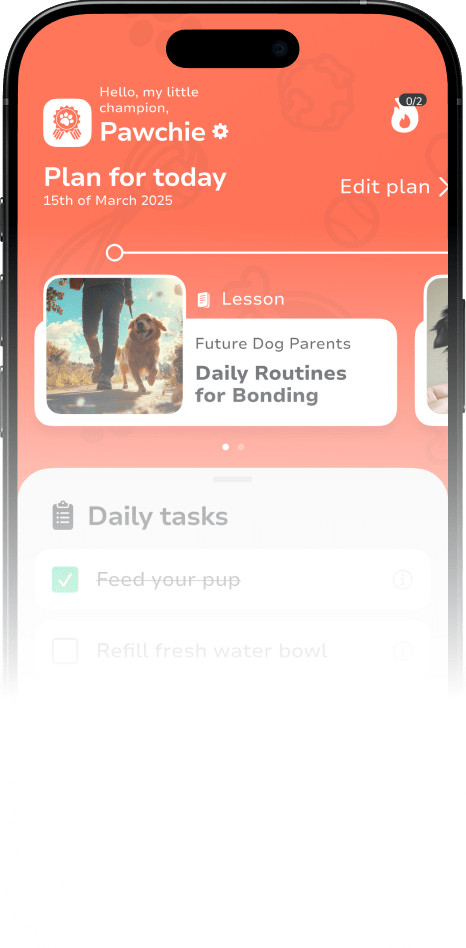
Knowing your dog's traits is step one — having a daily plan built around them is what actually moves the needle. PawChamp gives you structured training tailored to your dog's motivation, drive, and breed so you're not guessing what works.
6 Large Breeds That Are Delightfully Easy to Train
Let’s look at some breeds that check the majority of boxes when it comes to the “easy to train” checklist. To make this easier to picture, think of these dogs as students in a classroom. I’ve given each breed a personality so you know exactly what kind of learner you’re bringing home.
1. Labrador Retriever
Labrador Retriever, the food-motivated overachiever, has a natural eagerness to please and work with humans. In the classroom, this is the kid who sits in the front row, raises their hand for everything, whether they know the answer or not, and also asks for a snack break every 20 minutes.
They respond very well to positive reinforcement training methods and can be easily trained by kids as well as adults, as long as the communication is clear and consistent.
Don't let their goofy and sweet nature fool you. They were bred to be hardcore working dogs and need a great mix of physical and mental stimulation to be fulfilled.
2. Golden Retriever
Golden Retrievers are the polite but goofy ones in the classroom, always checking up on their friends, making them laugh, and never causing trouble. They are known to have the highest EQ in dogs, which makes them the ideal first-time family dogs.
Having said that, Golden Retrievers are often underestimated and get their patience tested time and again. This is the reason why we see so many Golden Retrievers today with resource guarding and aggression issues.
They can be raised to be calm and super well-behaved as long as the humans training them show respect and sensitivity towards their boundaries.
3. Standard Poodle
In a class, Standard Poodles would finish their assignment before you even explain it to them. They're not termed as the second most intelligent breed on the planet for no reason.
This breed is gifted with a high intelligence and a high trainability combo. They absolutely love a good challenge and will not give up easily. However, this kind of elite intelligence comes with a need to be stimulated more than other dogs.
They are also extremely sensitive towards their humans and environment, and can be more prone to behavioral issues like separation anxiety and fear aggression if not trained and socialized properly at an early age.
4. German Shepherd
The German Shepherds would probably be the class monitor with very strict adherence to rules. They watch everything, notice everything, and will give a detailed report to the teacher.
These dogs have a very strong work ethic and an unwavering focus. If you plan on adopting a German Shepherd, you will need a job for them and a robust training plan. They are an absolute delight to train because of their willingness to bond and work with humans.
They do well in households that can provide them with structure. They are also prone to developing behavioral issues if they don't receive the fulfillment they deserve.
5. Bernese Mountain Dog
Bernese Mountain Dogs are the laid-back backbenchers of the classroom. They are fast learners, but have zero urgency in life.
The trick with training Bernese Mountain Dogs is that you have to catch a pace that they are comfortable with and make sure they're having fun while doing it. They don't have a very high drive and are best suited for relaxed households.
They are prone to prolonged puppy-like behavior, which may last up to 3 years of age, and may display stubbornness or protective, loud watchdog behaviors if not properly trained.
6. Boxer
Boxers are the classroom jesters. They crack jokes, get distracted, play pranks, bump into desks… but somehow still understand the lesson.
Their goofiness makes training super fun. Every training session has a high likelihood of ending with a funny story/moment. They are high-energy dogs and do well with humans who match their vibe.
Some of the behavioral issues that you should be prepared to work through with a Boxer are separation anxiety, destructive chewing, excessive jumping, vocalization, and rough, rowdy play.
Common Mistakes to Avoid When Training a Large Dog
One of the most common mistakes I've seen people make with their large dogs is letting undesirable behaviors slide when they're a puppy. For example, a Labrador puppy jumping up on you is cute, but an adult Labrador doing the same thing can be a nuisance.
Some other common mistakes to avoid with large dogs are:
Inconsistency in setting rules (such as access to furniture, tolerance to jumping etc).
Not generalizing cues in different environments.
Training without structure.
Relying too much on treats as a source of rewards.
Not letting the dog engage in activities that fulfill the breed's needs.
💡 Think about it
The good news is that all of these are fixable — and catching them early makes all the difference.
How Can PawChamp Help?
Training a large dog isn't just about knowing the right commands — it's about timing, consistency, and knowing how to apply it all in real life. That's exactly where most owners get stuck.
PawChamp bridges that gap with a structured approach built around your dog's actual motivation — whether that's food, play, or engagement.
Here's what you get:
Step-by-step exercises and daily routines focused on obedience and real-world behavior.
Progress tracking so you can see what's working and when to move forward.
Guidance that translates beyond your living room — on walks, around distractions, in real situations.
Ask a Dog Expert chat when behavior gets tricky and you need a direct answer, not a Google rabbit hole.
Whether you're working through a specific behavior issue or building foundations with a puppy, PawChamp gives you the structure and support to actually get there.