Bonding with your dog starts in the tiny routines you repeat every day, which you both enjoy. If you’re wondering best ways to really bond with your dog, begin by focusing on habits that feel good for both of you. In this article, we will set you up for quick wins you can use today, guided by positive dog training that keeps things kind and effective.
Key takeaways:
Bonding works best when your dog feels safe, understood, and successful in small moments
Short, consistent sessions of dog bonding activities build a stronger “secure base” than long training marathons
Calm connection rituals can lower arousal and make learning easier
The right mix of play, cues, and enrichment can strengthen trust without pushing your dog over threshold
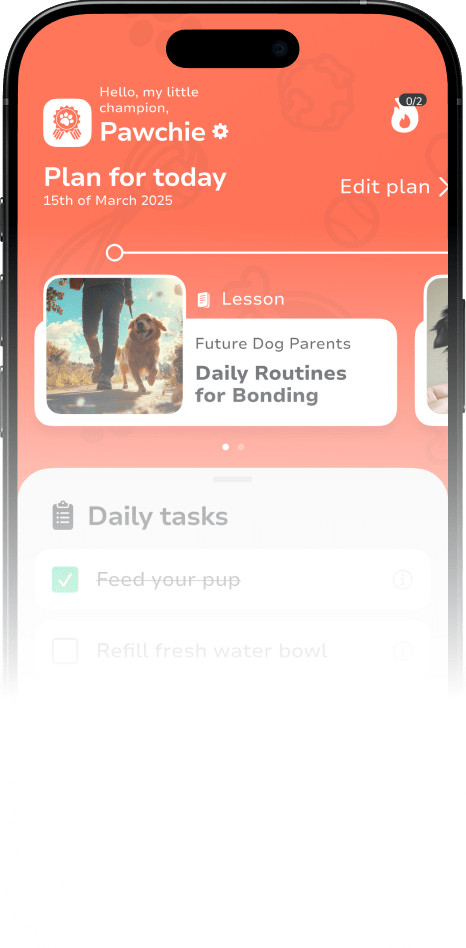
If you’d like a simple way to actually do these ideas (instead of saving them and forgetting), the Dog Love & Bonding Challenge in the PawChamp app is a great next step. It’s a gentle, day-by-day course with small activities like calm check-ins, connection walks, and enrichment games that make bonding feel easy and natural.
Understanding the Human-Dog Bond
Dogs do more than enjoy our company. Many use their person as a "secure base", which means they explore, learn, and cope better when the owner is present. That pattern mirrors attachment in children and helps explain why calm, consistent handling makes training easier.
Biology helps explain why simple activities with your dog (calm eye contact, soft talk, unhurried petting) work so well. The Science study showed that mutual gaze boosts oxytocin in both dogs and their owners, reinforcing attachment and making pleasant interactions even more rewarding over time.
💡 Note
Dogs also look to us for guidance in uncertain situations. They read facial expressions, voice tone, and posture, then adjust their behavior.
How to Build Trust With Your Dog?
Trust grows when your dog gets clear choices, quick wins, and a smooth shift from excitement to calm. To strengthen owner dog relationship, build short routines that mix movement, play, and simple cues. About 2-5 minute of sessions a few times a day will be enough.
Consent-based tug. Start with a "take it," end with "out," and restart. This style of interactive play with a dog teaches turn-taking, lowers frustration, and makes you the gateway to fun. Keep rounds short and end while your dog still wants more.
Fetch with a trade. Ask for "drop", pay with a second toy or treat, then send again. Clean swaps prevent resource guarding and speed up recalls.
Hide-and-seek recall. Using "stay" holds the dog while you hide. Call once, and your dog will celebrate like crazy when they find you. It’s a reliable dog trust-building game: your voice predicts success.
Nose work at home. Scatter treats in the grass or set up a 3-box search. Scenting is deep mental work and a safe form of physical exercise for dogs on hot or busy days.
💡Pro tip
Open PawChamp and pick one of the 90+ commands or games that fit your dog’s level. Watch the short demo, follow the steps, and practice in 5-minute bursts.
Relaxing Ways to Bond With Your Dog
Quiet time is not a pause from training; it is the training. Pick one corner of the living room, lay down a mat, and teach your dog that this spot means safety. Lure into a down, mark, feed a small treat between the paws, then breathe together for a few seconds before releasing. This counts as dog training at home, and over a week it becomes a reliable off switch.
Keep the energy low and let reward-based training do the heavy lifting. A simple hand target, a soft "settle", or short dog obedience commands like "sit" and "down" can flow into each other while you speak in a relaxed voice and deliver food slowly. If your dog struggles to unwind, layer in scent and licking. Offer a snuffle mat after two or three easy cues, or roll kibble into a towel and let them forage while you sit nearby. These are practical dog enrichment ideas that reduce arousal without adding chaos.
Touch helps when invited. Teach a chin rest to your palm, then stroke along the shoulders and chest for a few seconds, pause, and wait for your dog to re-offer the chin. That pattern builds trust, and it turns grooming or nail care into connection rather than a chore. Pair calm handling with predictable endings: a final treat on the mat, a release word, a short drink break.
Your dog learns that relaxing with you is safe, predictable, and worth it.
Mental Stimulation for Dogs
A tired brain is kinder than a tired body. When you treat training as a puzzle your dog can solve, everyday life becomes one of the best activities for dogs, and you naturally improve relationships with your dog.
Line up three boxes with one scented tin (tea bag or chamomile) and two blanks. Mark and a reward for investigating the right box. Each round, add distance, then a second “room,” then light breezes from a fan.
Pick two very different toys, for example, a bear and a ball. Cue “get Bear,” celebrate, then cue “get ball.” When success is 80%+, add a third toy, increase the distance, and then ask from another room.
Hide a treat under one of three cups. After two easy reps, add a rule: dog must glance at you first, or lie down before pointing. Rotate the cups slowly, then faster, then swap surfaces (mat → tile).
Dog Obedience Tips
For new skills in obedience training, pay fast: 10-15 rewards/min for the first 60-90 seconds, then slow to every 2-4 reps as success holds.
Use a clicker or crisp marker word such as “yes”, “OK”, “good boy/girl”, or “well done”. Mark the instant the behavior happens, treat within 1-2 seconds.
Say it once. If nothing happens in 2 seconds, lower the criteria or help with a lure. Don’t repeat the cue.
Feed where you want the dog to be (on the mat, at your left seam).
Work the 3Ds properly. Change only one at a time: Duration, Distance, or Distraction.
Proof in new rooms. Get 80-90% success at home, then redo in the hallway, yard, or sidewalk.
Build a release. Teach a clear "free". It prevents sticky sits/downs and makes the duration honest.
If you’d rather not guess what to train next, a PawChamp’s obedience personalized plan can map it out for you — starting from your dog’s current level and building step by step from there.
Building Daily Rituals
Rituals turn good intentions into habits your dog can trust. Anchor three short windows to your day and keep them predictable. This threads dog behaviour training into a moment you already have and sets a calm tone.
Keep play clever and calm. Fold in fun training activities for dogs that switch on the nose and brain, then land on a quiet settle. Pair them with effective dog training methods that include clean markers, honest releases, payment in position — and the bond starts to run on autopilot.
PawChamp keeps that rhythm simple: a library of 90+ commands and games with practical videos shows exactly what to do; all clips live in one video hub for bite-sized practices. Interactive quizzes reinforce each lesson, and daily streaks plus structured challenges keep you consistent and show progress over time.
Bonding Starts With You
Bonding with your dog is not a single “special moment.” It is the result of small, repeatable interactions that make your dog feel safe, successful, and understood. Short training bursts, consent-based play, and calm rituals do more than teach skills. They build trust, improve focus, and make everyday life smoother for both of you.
Summary: Keep it simple, stay consistent, and choose routines you can repeat even on busy days. If you want a ready-made structure for that consistency, the Dog Love & Bonding Challenge in PawChamp gives you small daily activities that are easy to follow and hard to forget.