Does my dog love me? Our dogs, by default, are not subtle romantics. Dog love is often manifested to the point of being mildly inconvenient, but sometimes the signs of attachment are so ordinary that pet parents miss them entirely. With this in mind, here are some key takeaways about signs your dog loves you.
Key Takeaways:
Dogs frequently show love through emotional regulation. A dog who settles more easily around you may see you as a source of safety.
Many affectionate behaviors are biologically rooted. Certain types of interaction can increase oxytocin in both dogs and humans.
Dogs often show love through proximity-seeking. This is their way of manifesting social attachment.
Interpretation of affectionate behaviors should rely on the full behavioral picture rather than the behavior alone.
Understanding canine affection requires observing patterns over time rather than focusing on isolated moments.
How to Tell If Your Dog Loves You?
Unlike humans, dogs do not send love cards, flowers, or pause mid-afternoon to reflect on the poetic significance of your relationship, so when pet parents ask how to tell if your dog loves you, they are usually projecting a very human communication style onto an animal that operates on a different system entirely.
Dog love is not built around symbolism or abstract narratives, but more on immediate experiences and social attachment processes shaped by domestication.
Therefore, if you are looking for signs your dog loves you, look past the love cards and instead focus on dog behavior, meaning keep your focus on behavioral data.
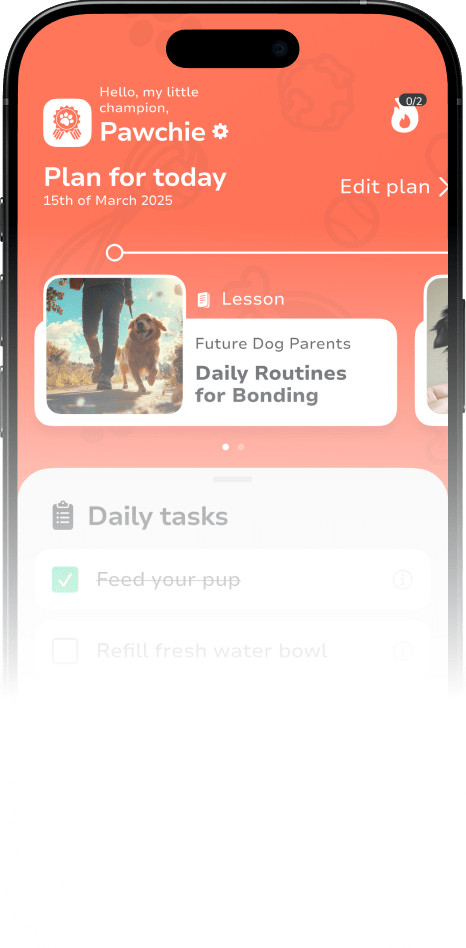
If you want to read these signs with less guesswork, PawChamp breaks down common “love vs stress vs habit” behaviors in simple, trainer-built lessons, so you can stop overthinking and start noticing the patterns that actually matter
How Dogs Show Love Through Body Language?
Dog love is typically expressed through dog body language and clusters of behavior patterns that reflect attachment, emotional regulation, and dog trust signals.
Because of this, “how dogs show love” is better understood as how dogs behave when they are socially comfortable and not under stress.
A dog that feels safe with a person will typically show fewer avoidant behaviors, less tension in the body and more willingness to consistently choose to remain near a person without being pressured. This proximity is meaningful because it is voluntary and persists across neutral, low-stimulation environments, not just high-excitement contexts.
Sign 1: Eye Contact With Your Dog
Eye contact is a sign of a stable dog-human bond as it’s associated with reduced threat perception and increased social referencing.
Among animals, studies have found that eye contact is a significant signal of affiliation and cooperation with humans. Studies have also found that when dogs and their pet parents gaze into each other’s eyes, the love hormone oxytocin is released.
When it comes to dog body language, it doesn’t get clearer than that. Eye contact is one of the most prominent dog trust signals.
A dog who feels safe is more likely to orient visually toward a person without showing tension, such as stiff posture, hard staring, or avoidance, as long as the eye contact remains soft and the body language relaxed.
Sign 2: Dog Leaning on You
In the past, a dog leaning on you was perceived as a dog’s attempt to gain “status” or control over humans. Fortunately, nowadays we know better as we have abandoned outdated dominance-based frameworks.
In reality, a dog leaning is one of those puppy love signs that are far more consistent with social attachment, reinforcement history, or simple physical contact-seeking behavior than any attempt at dominance.
Dogs are social animals who use proximity and body contact as a way to how dogs show affection. However, context still matters.
Some dogs may also lean when they are feeling stressed uncertain, or protective. Others have simply learned that leaning leads to petting and attention from humans and is therefore shaped by reinforcement.
If you want an easier way to tell the difference, PawChamp has short, practical guidance on reading body language clusters (not single signals) in the app so you can respond in a way that builds trust instead of accidentally adding pressure
Sign 3: Dog Licks Me — What It Really Means
My dog licks me. What does this mean? As a dog trainer, this, along with “how do dogs show affection,” is one of the most common questions I receive from caring pet parents.
So why do dogs lick you? Licking can absolutely be an affiliative behavior in dogs, but, like other behaviors suggestive of canine affection, it’s important to consider the accompanying body language and context.
While licking may be a sign of social bonding, it can also be a way for the dog to gather information, seek attention, and manifest stress or appeasement. And of course, some dogs may lick you simply because they like how you taste!
A simple way to interpret licking is to check what comes with it:
Loose body + soft face + wiggly approach usually means social bonding or excitement
Licking + head turns + yawns + tight mouth often means appeasement or “please give me space.”
Sudden, intense licking that looks compulsive can be stress-related and worth tracking
Sign 4: Dog Follows You Everywhere
Does my dog love me if he’s following me from room to room? This is another great question. Once again, in order to obtain the most accurate dog behavior meaning, it’s important to pay attention to context and the accompanying body language.
A dog following you everywhere can absolutely be a sign of deep social attachment, but it should not automatically be interpreted as “love” in the purely emotional or romanticized sense humans often assume.
Dogs are social animals that evolved alongside humans, and the dog-human bond is certainly strong. Proximity itself is likely perceived as rewarding, especially in dogs who follow casually, settle, and do not show distress during temporary separation.
Following you around may also be a way for dogs to monitor your activities, especially if they have come to notice how they predict activity, food, walks, or stimulation. And then, in some cases, excessive following may reflect anxiety rather than relaxed attachment.
So yes, the following behavior is often associated with affection and attachment. But clinically, it is best understood as proximity-seeking behavior that may reflect trust, social bonding, learned association, routine monitoring, or anxiety, depending on the context and emotional state of the dog.
Sign 5: Dog Sleeping on Your Clothes
A dog sleeping on your clothes is endearing, especially when they are curled up in a cute ball and treating your freshly folded laundry like an emotional support mattress, but is that also a sign of potential love and affection?
This cute behavior can certainly reflect social attachment and comfort-seeking behavior; however, we must proceed with caution before we label it as sentimental.
For example, let’s consider that dogs are strongly guided by scent, and human clothing carries concentrated familiar odor cues that are associated with safety, predictability, and social bonding.
Is my dog happy if he’s sleeping on my clothes? Sure, this behavior can be interpreted as one of the most prominent dog trust signals, asyour scent predicts safety, routine, social contact, and emotional stability, but it can also be that your dog is simply seeking soft, warm surfaces.
Sign 6: Dog Brings You Toys
Among the many puppy love signs, a dog bringing you toys can absolutely be part of affiliative social behavior. Although it is not a deliberate “gift-giving” gesture, it still reflects social engagement and a positive association with you.
It’s an adorable invitation to interact, cooperate, or share attention. Most likely, if your dog brings you toys routinely, he has learned that approaching you with an object reliably predicts social reinforcement: play, verbal interaction, attention, or emotional engagement.
“Is my dog happy if he brings me toys when he greets me?” I get this question a lot. Dogs often bring toys during greetings because greeting events create high emotional arousal, and carrying an object helps regulate that excitement.
Bringing you toys is therefore another way how dogs show “love,” in terms of social attachment, play invitation, and a way to channel excess energy associated with emotionally significant events.
Dog-Human Bond: Why Does My Dog Love Me?
Sure, your dog is not writing emotional poetry about your relationship, but we cannot deny the fact that the dog-human bond is very strong and built through repeated experiences involving safety, predictability, social interaction, and reinforcement.
So when pet parents ask, “does my dog love me?,” the answer is that while they may not love in the abstract sense.
So how do dogs show affection? It’s mostly evident through proximity-seeking, relaxed body language, and voluntary engagement. Look for signs through ordinary behaviors such as resting nearby, checking in visually during walks, leaning against you, bringing toys, or calmly following you around, from room to room.
Is My Dog Happy? How to Know for Sure
When pet parents ask me, Is my dog happy? I often have to remind them to look beyond isolated episodes of tail wagging or excitement. Rather, it is best if emotional well-being is assessed through consistent behavioral patterns across time and environments.
One of the more reliable signs your dog loves you is not hyperactivity, but the ability to remain relaxed and emotionally regulated in your presence.
Understanding dog behavior meaning also requires context. A wagging tail alone does not automatically indicate happiness. Behavior must always be interpreted alongside posture, facial tension, environment, and the dog’s overall arousal level.
A happy dog is typically one that feels safe, predictable, socially connected, and able to engage normally with the environment and familiar people.
How PawChamp Helps?
If you’re reading this because you genuinely want to know “does my dog love me?”, you’re already doing the right thing: paying attention to behavior instead of guessing
PawChamp helps you turn that attention into a clearer plan by showing you what to look for in real life, not just in theory
Inside the app, you can learn how to read trust and stress signals as clusters, build calmer daily routines that support secure attachment, and use step-by-step exercises that improve communication without pressure
If you’re stuck on a specific behavior (clingy following, licking, over-arousal during greetings), you can also use Ask a Dog Expert to sanity-check what you’re seeing and get a safer next step.
The Bottom Line
Los perros no expresan "amor" mediante gestos simbólicos o discursos emocionales. Más bien manifiestan su apego hacia nosotros a través de la proximidad, la confianza, un lenguaje corporal relajado, el compromiso social y la regulación emocional. En muchos casos, los comportamientos cotidianos y silenciosos que los dueños apenas perciben son los indicadores más claros del vínculo entre el perro y el ser humano.
References:
Siqi Yuan, Yong Q. Zhang, The effects of oxytocin on social behavior and eye gaze: Insights from dog-human partnership, Neuroscience & Biobehavioral Reviews, Volume 184, 2026.
Nagasawa, Miho & Mitsui, Shohei & En, Shiori & Ohtani, Nobuyo & Ohta, Mitsuaki & Sakuma, Yasuo & Onaka, Tatsushi & Mogi, Kazutaka & Kikusui, Takefumi. (2015). Oxytocin-Gaze Positive Loop and the Coevolution of Human-Dog Bonds. Science