Everyone wants to know: how long does it take to train a dog? The short answer is that basic commands can click in a few weeks, but real, reliable behavior takes months. The longer answer depends on your dog, your consistency, and the skill you're working on. Before you get discouraged — or overconfident — here's what the timeline actually looks like, broken down by skill and stage.
Key Takeaways
- Basic commands like sit can take as little as a few days to a few weeks to learn.
- Reliable, real-world obedience typically takes several months of consistent practice.
- Potty training usually wraps up in two weeks to three months, depending on age and routine.
- Consistency beats intensity — short daily sessions outperform occasional long ones every time.
- Your dog's age, breed, and your training method all quietly shape how fast progress comes.
How Long Does It Take to Train a Dog? The Honest Answer
Here's the honest version: most dogs pick up basic obedience — sit, stay, come — within two to eight weeks of regular training. But picking up a skill and reliably performing it in a busy park with squirrels everywhere are two very different things. Full reliability across varied environments usually takes three to six months, sometimes longer.
Puppies and adult dogs are also on different tracks. A young puppy is learning everything for the first time, which means more repetition but also a brain that's wired to absorb new information fast. An adult rescue dog may already have habits to unlearn before new ones can stick. Neither is harder — just different.
The biggest mistake new owners make is quitting around week three, right when progress feels slow. That's actually when the foundation is being laid. Stick with it, and the breakthroughs come.
How Long Does It Take to Train a Dog? The Honest Answer
🔄 Remember:
Quitting around week three is the most common mistake new owners make — but that's exactly when the foundation is being laid. Progress often feels slow right before the breakthroughs start coming.
Training Timelines by Skill
Not all skills are created equal. Here's a rough guide to how long common training goals typically take:
- Sit: 1–2 weeks for a solid response
- Stay: 2–4 weeks to build duration and distance
- Recall (come when called): 4–8 weeks for a reliable response; ongoing proofing for life
- Loose-leash walking: 1–3 months of consistent practice
- Leave it / drop it: 2–6 weeks depending on the dog's drive
- Service dog skills: 18 months to 2+ years of specialized, structured work
These are guides, not guarantees. A motivated Border Collie and a laid-back Basset Hound will move at very different speeds — and that's perfectly fine. Two milestones tend to dominate owners' minds more than any others: potty training and crate training.
Potty Training Timeline
How long does it take to potty train a puppy? Most puppies get the idea within two to four weeks if you're consistent with schedules and rewards. True reliability — no accidents, even overnight — usually takes two to three months. Some puppies nail it faster; some take a little longer, especially if the routine has gaps.
The question owners really ask is: how long should it take to potty train a puppy? A fair benchmark is four to six weeks for daytime control, and up to three months before you can trust them fully. If you're still seeing frequent accidents past the three-month mark, it's worth reviewing your schedule rather than blaming the dog. You might also want to think about how long your dog can realistically hold their pee overnight — because expecting too much too soon is one of the most common reasons potty training drags on.
A structured routine is the single biggest lever on potty training speed. Taking your dog out at the same times each day, rewarding immediately after they go outside, and limiting unsupervised indoor time all push you toward the shorter end of the range.
House and Crate Training Timeline
House training and crate training overlap heavily, so it makes sense to look at them together. Most dogs become comfortable inside a crate within a few days when introductions are gradual and positive — never forced. Genuine, settled independence in the crate (door closed, no whining, happy to rest) typically develops over two to four weeks.
How long does it take to house train a puppy in a broader sense? Expect four to eight weeks for solid daytime routines, with nighttime reliability following a few weeks behind. Adult dogs often adjust faster because their bladder control is better — many adult rescues are reliably house-trained within two to three weeks of a consistent routine. Knowing how long dogs can reasonably hold their poop helps you set a schedule that actually matches their biology rather than your wishful thinking.
What speeds things up: consistent schedules, positive crate associations (meals, favorite chews), and calm, uneventful alone time built up gradually. What stalls it: rushing the process, using the crate as punishment, or giving too much freedom too soon.
⏱️ Tip:
If your puppy hasn't gone to the toilet within 15 minutes of being taken outside, bring them back in, keep an eye on them, and try again in another 10–15 minutes. Waiting them out in the cold for 45 minutes teaches neither of you anything useful.
What Affects How Fast a Dog Learns
Training timelines aren't random — several real variables shape them. Understanding these helps you set honest expectations and stop blaming yourself (or your dog) when progress feels slow.
- Age: Puppies between 8 and 16 weeks are in a prime socialization window and absorb new experiences quickly. Older dogs can absolutely learn new skills, but ingrained habits take more time to shift.
- Breed and drive: Working breeds (Border Collies, German Shepherds, Poodles) are often highly motivated and fast learners. Independent breeds (Basenjis, Chow Chows) may require more patience and creative rewards.
- Consistency: A dog trained for 10 minutes every single day will almost always outpace one trained for an hour on weekends. Frequency matters more than duration.
- Session quality: Short, focused, upbeat sessions beat long, repetitive slogs. End on a win, every time.
- Environment: A dog who performs beautifully at home may fall apart at the dog park. Gradually training in new environments is part of the process, not a sign of failure.
- Training method: Positive reinforcement consistently produces faster learning and longer-lasting behavior than punishment-based approaches, according to research from the University of Porto.
The throughline across all of these? Consistency beats intensity, every single time.
How to Train Your Dog Faster
You can't rush a dog — but you can absolutely waste time with scattered, unfocused effort. Here's what actually accelerates training:
- Keep sessions short: 5–10 minutes, two to three times a day, is more effective than a single 30-minute marathon.
- One skill at a time: Master sit before adding stay. Trying to juggle five behaviors at once dilutes progress on all of them.
- Use high-value rewards: Your dog's kibble might not cut it when there are distractions around. Small pieces of chicken, cheese, or their favorite treat raise the stakes and speed up learning.
- Train in the real world: Once a skill is solid at home, start practicing on walks, at friends' houses, and in busier environments. This is called "proofing," and it's where reliability actually comes from.
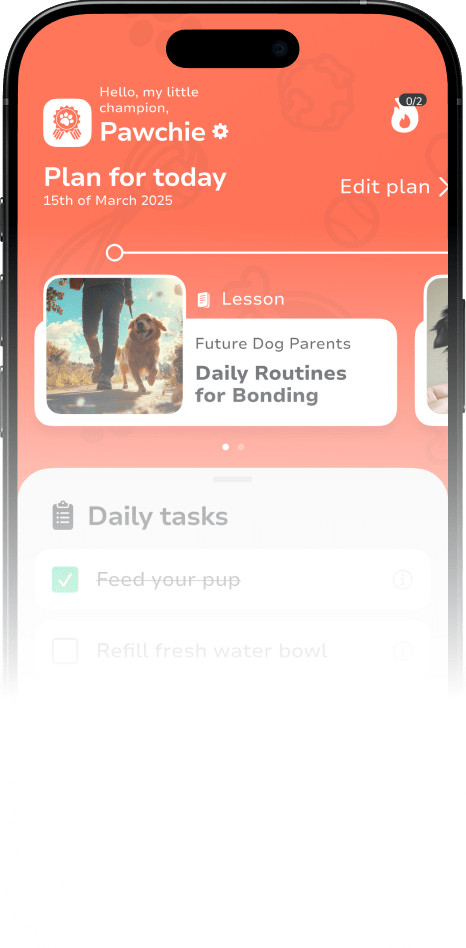
- Follow a plan: Scattered effort is the number-one reason training drags. A consistent, structured plan removes the daily question of "what do I work on today?" and keeps momentum going.
A Realistic Puppy Schedule by Age
A loose age-based roadmap makes the whole process feel more manageable. Here's what to focus on at each stage:
- 8–10 weeks: Name recognition, sit, potty training basics, gentle handling and socialization. Sessions: 3–5 minutes, several times a day.
- 10–12 weeks: Sit, down, come, crate comfort. Start building a consistent potty schedule. Sessions: 5 minutes, two to three times a day.
- 3–4 months: Stay (short duration), loose-leash walking, leave it. Potty training should be well underway. Sessions: 5–10 minutes, twice daily.
- 4–6 months: Proofing basics in new environments, longer stays, recall in low-distraction areas. Most puppies hit daytime potty reliability around now.
- 6–12 months: Continued proofing, more complex behaviors, working toward full reliability. Adolescence may bring temporary regression — stay consistent and it passes.
Remember: this is a guide, not a report card. If your four-month-old is still working on sit in distracting environments, that's completely normal. Just keep the sessions short, keep them positive, and keep showing up. And if you're wondering how long your pup can hold it while you're at work during this stage, it's worth checking what's actually a fair ask for dogs left home during the day — the answer might reshape your whole schedule.
🐾 Fun Fact:
Dogs can learn the meaning of over 165 words and signals, according to research by psychologist Stanley Coren. The average dog understands roughly as many words as a two-year-old child. So yes, your dog understands more than they let on — they're just negotiating.
How Can PawChamp Help?
PawChamp turns "how long will this take?" into a clear daily plan tailored to your dog's age and progress. Instead of training in frustrated bursts or wondering whether you're doing it right, you get a structured routine that keeps sessions short, skills building logically, and momentum consistent. Because the single biggest factor in how fast your dog learns isn't their breed or their age — it's how reliably you show up for them.
Bottom Line
There's no single number when it comes to how long dog training takes. Basic commands can click in a matter of weeks; real-world reliability takes months. Your consistency sets the pace more than anything else. Train little and often, keep sessions positive, and you'll likely be surprised by how fast progress comes when you stop trying to rush it.