You've scrolled the listings, read the reviews, maybe even joined a waitlist — and still there's no good dog trainer within reach. It's a frustrating spot, especially when your dog needs help now. Here's the reassuring part: you don't need a local trainer to raise a confident, well-mannered dog.
Learning how to train your dog from home is more doable than ever, whether through live online coaching, simple reward-based routines, or a dog training app that guides you one step at a time. Let's walk through exactly what to do instead.
Key Takeaways
A missing local trainer doesn't hold your dog back — remote and at-home options genuinely work.
Online coaching and apps deliver structured, force-free plans you can follow from anywhere.
Most everyday manners can be taught in short, consistent, reward-based sessions at home.
Free and low-cost options exist; structure and support are what make the training actually stick.
Serious aggression or a bite history still calls for a qualified in-person professional.
No Dog Trainer Near You? Why Local Options Fall Short
If searching dog trainer near me keeps turning up dead ends, you're in good company. In many areas, a quick dog training near me search returns month-long waitlists, an hour-long drive, or trainers who still lean on outdated punishment-based methods.
Cost and fit matter just as much as distance. If you've ever wondered where to send your dog to be trained, the honest answer is that the right help isn't always the closest — and increasingly, it doesn't have to be local at all.
Affordable and Free Dog Training Near You
Price is the other wall. Private, in-person sessions can run well over a hundred dollars an hour, which sends most people hunting for affordable dog training near me or even free dog training near me. A few local options are worth checking before you rule out hands-on help:
Animal shelters and rescues that run budget-friendly group classes.
Community centers and libraries with occasional low-cost training events.
Group obedience classes, which cost far less than private one-on-one lessons.
Puppy socials or clinics hosted by local pet stores.
These are great for the basics and for socializing, but slots fill fast and rarely cover specific behavior problems — which is exactly where a low cost dog training near me search tends to hit its limit.
Online Dog Training: Coaching From Anywhere
When the map comes up empty, the internet fills the gap. Online dog training connects you with real coaching through video calls, structured lessons, and feedback — no commute required.
You've got two broad routes. Live virtual dog training lets a trainer watch you and your dog over video and correct you in the moment, while self-paced online dog training courses hand you a full curriculum to work through on your own schedule.
Either way, dog training courses online remove the two biggest barriers — distance and price — though they do ask one thing of you: you become the person running the sessions.
💡 Trainer's insight
Most everyday obedience — sit, recall, loose-leash walking — is taught the same way whether a trainer is in the room or on a screen. What actually drives results is your consistency between sessions, not the trainer's physical presence. A good remote program spends as much time coaching you as it does your dog.
Dog Training at Home: What You Can Teach Yourself
Here's what surprises most people: the bulk of everyday training is dog training at home, not something that only happens in a classroom. Sit, down, recall, settling on a mat, polite greetings — all of it can be built in your own living room.
At home dog training works because dogs learn best in short, frequent bursts in a low-distraction space, which is exactly what your home offers. If loose-leash walking is your goal, the same principles apply indoors first — our leash training techniques guide is a good place to begin.
A simple starter routine for how to train a dog at home looks like this:
Pick one behavior to work on at a time.
Keep sessions short — around five minutes, a few times a day.
Mark the instant your dog gets it right, then reward immediately.
Once it's reliable, practice in a new room or add mild distractions.
Track your wins so you can see progress and stay motivated.
Follow that loop and you'll cover most of what a beginner class teaches — the real difference is simply the method you choose.
How to Train Your Dog With Positive Methods
The method matters more than the venue. The gold standard for how to train your dog is reward-based, force-free dog training: you reward what you want and prevent or ignore what you don't, with no fear, pain, or "alpha" nonsense.
This approach isn't just kinder — it's more effective. A 2020 study in Frontiers in
Veterinary Science found that reward-based training was the most effective approach, outperforming methods that relied on aversive tools.
Knowing the method is one thing; knowing what to do on Tuesday with your specific dog is another. A guided plan takes that guesswork off your plate.
Answer a few quick questions about your dog and get a personalized, force-free training plan you can start today.
Best Dog Training Apps and Free Resources
If you'd rather not piece it all together yourself, a dog training app does the sequencing for you — turning a vague goal into a clear daily to-do list.
Free tools can get you moving, too. There are genuinely useful free dog training apps, plus a lot of solid free dog training on reputable video channels, and many owners start with a free dog training app before deciding what they really need.
So what separates the best dog training app from filler? Look for a real, progressive curriculum, honest progress tracking, and access to human help — that's the gap between the best free dog training app you actually finish and one you delete in a week. For a side-by-side look, our best dog training apps comparison breaks down the leading options.
💡 Did you know?
Short, daily practice beats one long weekly lesson for most dogs. A five-minute session you actually repeat builds reliable habits faster than an hour you do once and forget — which is precisely why app-based reminders and bite-sized lessons tend to stick.
The Dog Training App That Replaces the Trainer Down the Road
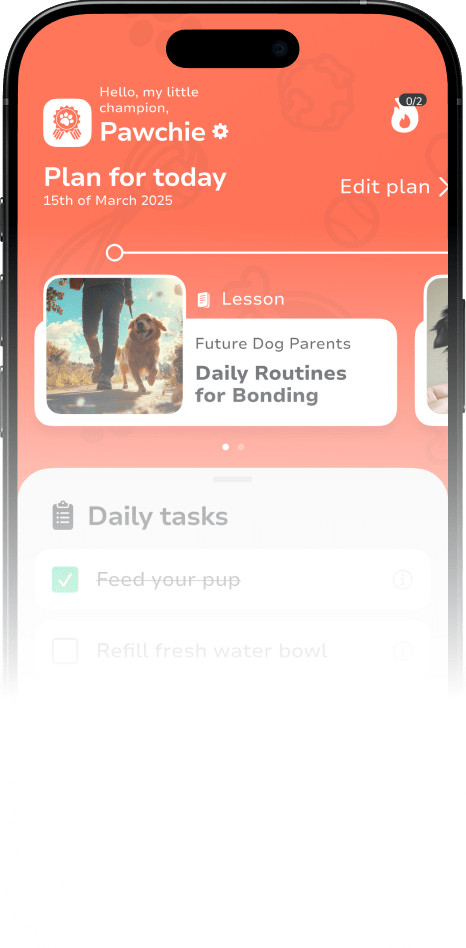
When there's no trainer nearby, PawChamp puts one in your pocket. Instead of a generic checklist, PawChamp builds a personalized, force-free plan around your dog's age, breed, and behavior, then breaks it into bite-sized daily lessons you can do at home.
Stuck on something specific? The Ask a Dog Expert chat lets you message a certified trainer for advice tailored to your dog — the reassurance a local class would give, minus the drive and the waitlist. Built-in progress tracking keeps you consistent, which, as we've seen, is the real secret to results.
PawChamp is honest about its limits, too. If your dog has a bite history or serious aggression, that's a job for an in-person professional, and options like classes for aggressive dogs are the safer route.
Bottom Line
No trainer nearby isn't a dead end — it's just a fork in the road. Between online coaching, at-home practice, free resources, and a well-built app, you can cover almost everything most dogs need, as long as you keep sessions short, positive, and consistent. Start with what you have today, celebrate the small wins, and call in an in-person professional only for the issues that truly require one. Your dog doesn't need the perfect trainer down the street — they need a plan and a person who shows up. That person is you.